Part 1 of 8 — Anthropic Equity Decision System
Your Anthropic IPO Game Plan: What to Decide First and What Can Wait
Anthropic's IPO is weeks away — here's which decisions you can't undo, which can wait, and how I'd handle the ones due this week.
Which Anthropic IPO decisions are permanent, and which can you refine later?
Why does the IPO create a 2026 tax bill before most of your shares can be sold?
How is selling different at Anthropic than at most newly public companies?
What should you do this week?
On October 26th, Anthropic filed its S-1, which is a key step to going public (required 15 days prior to IPO; Ticker: ANT). No price range yet, but rumors are a $1.5T to $2.0T price target, which is roughly up 50-100% vs. pricing earlier this year.
While this step was highly anticipated, if you're an Ant your ability to sell shares to the public just went from "someday" to "a few weeks from now."
I spent a big chunk of this year walking SpaceX employees through their IPO and lockup, and a lot of that playbook carries over. But in three ways that matter a lot for your money, Anthropic's IPO is very different:
Unique lockup with a 3 step release. You can sell 10% on the first trading day, another 35% after the FY26 earnings release (both of these without a 10b5-1 plan), and then the remaining 55% of your shares can be sold after Q1 2027 earnings or day 180, whichever comes first (these will likely require a 10b5-1 plan).
As an employee, you'll be required to have a 10b5-1 plan. Outside of the lockup releases (see below) there are no quarterly open trading windows like most public companies have. You will need to set up a plan in advance, during a short window after an earnings release, then wait out a cooling-off period before it trades.
Your RSUs are double trigger and will pay out at the IPO (along with the tax bill).
Every RSU with time-vesting met will now formally vest when the IPO registration goes effective. That will create a lot of W-2 income in 2026.
Each decision gets its own deeper guide in this series. But before those are useful, you need to know which decisions are on the critical path, which can wait, and what to do right now.
TL;DR: The Dates That Actually Matter
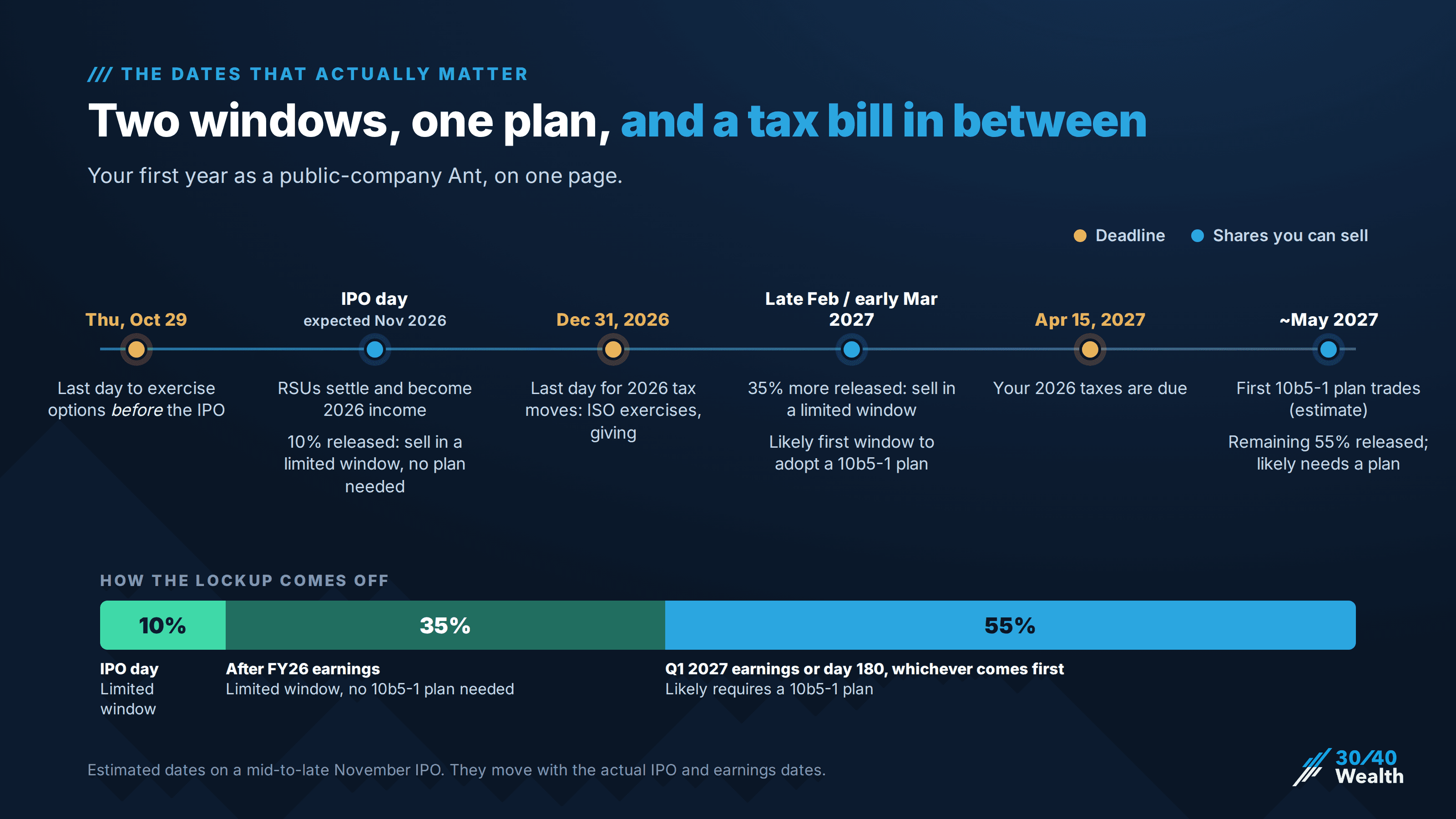
Thursday, October 29, before 5pm Pacific: if you want to exercise options before the IPO, your exercise has to be submitted before the equity platform goes offline. It stays dark for about two weeks. Miss it and you can still exercise later in 2026, just not before the IPO.
IPO day: two big items occur. (1) Your service-vested RSUs settle and become 2026 income, with taxes withheld at the rate you elected (if you had a choice). (2) 10% of your locked-up shares are released and able to be sold.
December 31: The end of the tax year your RSU income lands in. That makes 2026 an unusually good year for some moves (ISO exercises, charitable gifts) and a bad year for others. December 31st is the last date for you to do any of those.
Late February or early March 2027: the FY26 earnings release frees up another 35% of your shares you're eligible to sell, and it's also likely to be when the first window to adopt a 10b5-1 sell plan opens.
The most important decision, how much ANT you want to own long term, doesn't have a deadline this week. But it should drive every decision that does.
The Decision Map: What Matters Now vs. What Can Wait
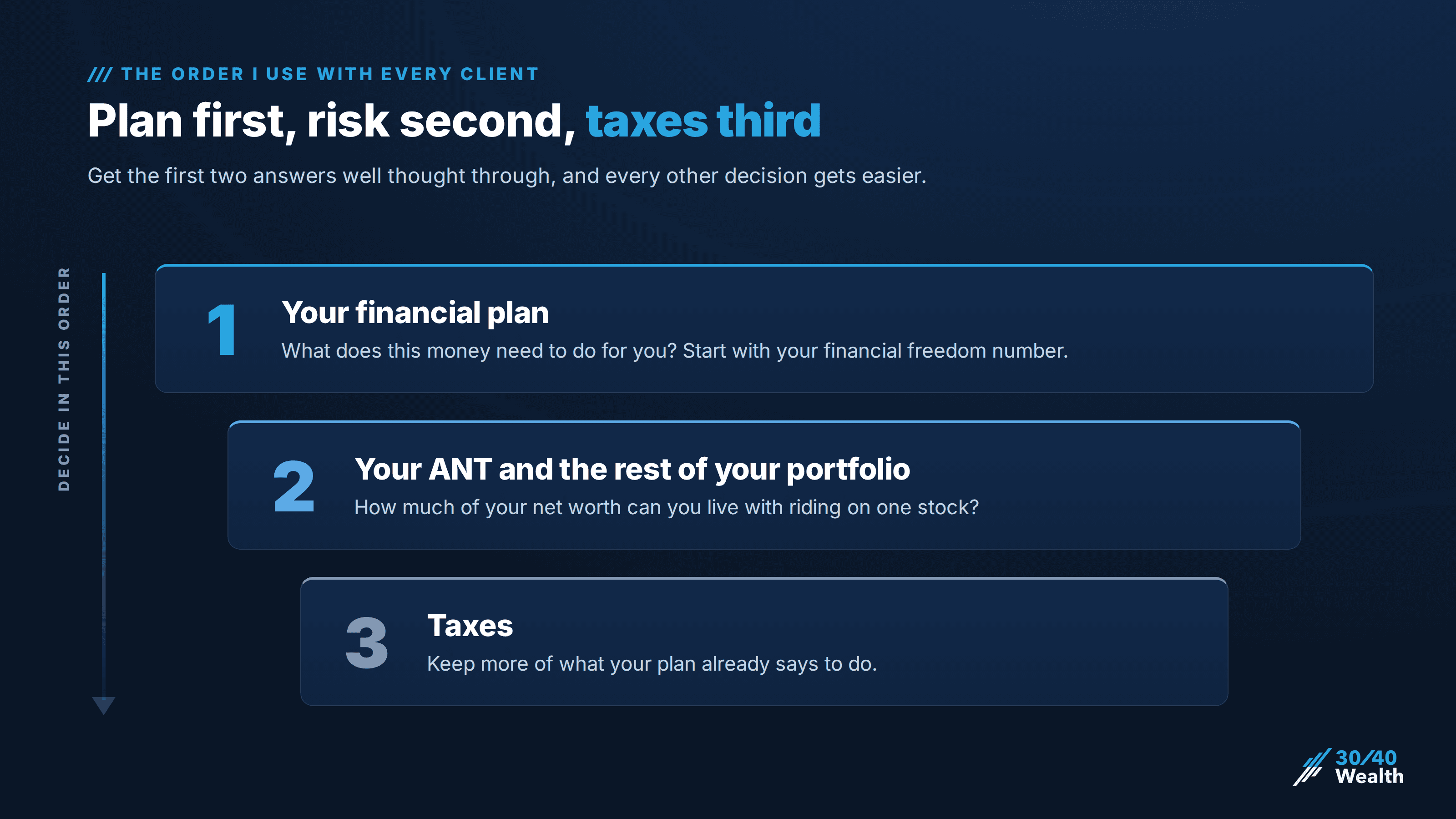
Ensure you prioritize by what matters: your financial plan first, your ANT and the rest of your portfolio second, taxes third. In practice, that means two things. Put a number on what this money needs to do for you (your financial freedom number is a good place to start). And be honest about how much of your net worth you can live with riding on one stock (easy when it goes up, a lot harder when it goes down; and most go down over time). Once those two answers are well-thought-through, every other decision here gets easier.
Most Ants are working with some mix of double-trigger RSUs, older stock options, shares from past exercises and, for some, a donation-match pledge. (The new ESPP is interesting, but for most Ants its impact is a rounding error.) Every one of those changes how much of your net worth ends up in ANT.
Four of the decisions below can't be undone once you make them: an option exercise, your withholding election, a charitable gift and a signed 10b5-1 plan. Those get your attention first. Everything else (how much to sell, what to invest in, how much ANT to keep long term) can be refined as you go. The list is ordered by deadline, not by importance.
Do These Now (Before the IPO or Right After It)
1. Map your complete equity inventory (and download it before Thursday).
Before you can make a single good decision, you need to know exactly what you have. This sounds obvious. It almost never happens.
A full picture means every grant and grant date, and for each one: how many RSUs will have met their service vesting by IPO day (that number drives your 2026 tax bill); which options are ISOs versus NSOs, and their strike prices; vested versus unvested counts; any shares you already own; and, if you've exercised ISOs before, your AMT credit carryforward.
And do it before Thursday afternoon. When the equity platform goes offline, you can't see your account or download anything for about two weeks. If you (or your CPA or your financial advisor like 30/40 Wealth) need grant details for planning in early November, pull the reports now.
This is very likely the biggest wealth generator you'll have in your lifetime. It's worth the hour.
2. Decide on your RSU withholding rate, if you're given the choice (permanent once your RSUs settle)
When your RSUs settle, shares are held back to cover taxes. If Anthropic lets you choose the federal withholding rate (as many companies do at IPO), this is a real decision, not a form to click through. Whether Ants get that choice, and by when, is still TBD as of the writing of this article, so find out now.
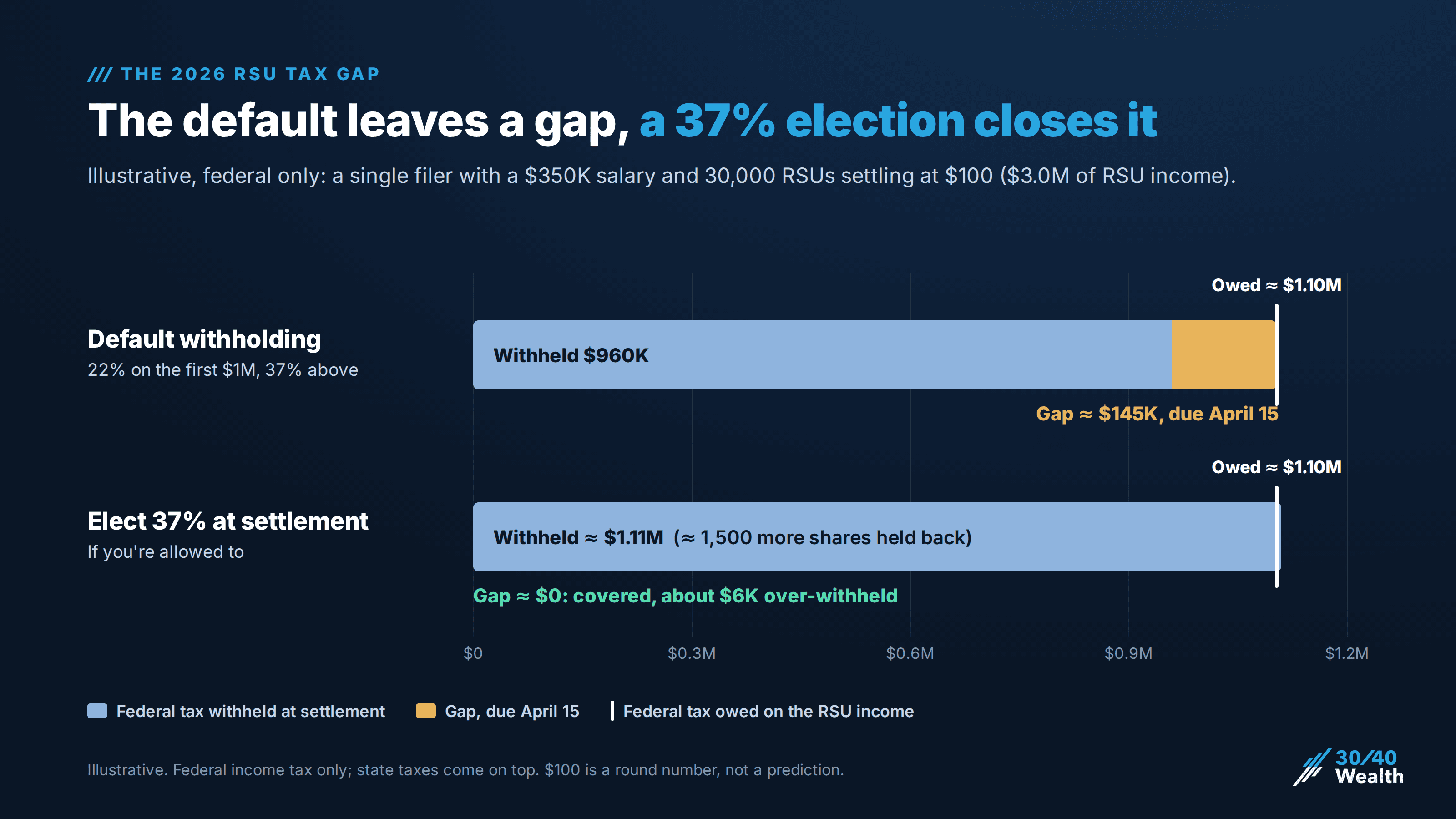
The default federal rate is 22% on the first $1 million. Electing a higher rate (e.g. 37%) means more shares are force-sold on your behalf by Anthropic to cover your tax bill, and thus a smaller (if any) tax bill due in April.
How I'd typically advise most clients: elect the higher rate. It's the closest thing you'll get to selling at the IPO price, and it keeps April from becoming a fire drill and requiring a lot of cash and possibly underpayment penalties/fees. The rare exception is someone who's very bullish, already has the April cash set aside, and wants every share they can keep.
3. Decide whether you want to exercise any options before the IPO (the deadline is Thursday) (permanent)
If you want to exercise ahead of the IPO, your exercise has to be submitted before the equity platform shuts down on Thursday, October 29, at 5:01pm Pacific. It's expected back around i mid-November. After that, you can exercise for cash at any time, including during the lockup.
Start with the plan, not the tax. Exercising requires you pay cash out the door now (and possibly owe AMT in near future) before you can sell anything. So the first question is whether you want more economic exposure to ANT through the IPO, and if you have the cash to do so. If the answer is yes, here's why someone might do it before the IPO:
The taxable spread is measured at the company's current fair market value. Anthropic stock fair market value right now pre IPO is around $57 a share. If ANT trades meaningfully above that, exercising now means a smaller spread, which means a smaller tax hit (AMT for ISOs, ordinary income for NSOs).
The ISO holding clock starts sooner. Long-term capital gains treatment on ISO shares requires holding them one year from exercise (and two years from grant).
Why a lot of people shouldn't rush it:
You're committing more dollars to your ANT position that you're already heavily concentrated in, before you know what it's worth and before you have full selling flexibility.
For ISOs, 2026 is likely the year with the most free room you'll ever have to exercise ISOs but not trigger AMT (because of the RSU income), and that room is there through December 31. Not just through Thursday.
I have no idea where ANT prices or trades. If it lands below the last fair market value, exercising early cost you.
Said another way: Thursday is the deadline for exercising before the IPO. It isn't the deadline for exercising in 2026. For most Ants with ISOs, December 31 is the date that matters more (the options guide in this series goes deep on why). And if you ever leave Anthropic, you have up to 10 years to exercise vested options, but ISOs exercised more than three months after you leave are taxed as NSOs.
How I'd typically advise most clients: don't rush Thursday. The exception is someone who already planned to exercise and hold, has the cash, and is comfortable betting ANT prices well above the current fair market value. Everyone else can make this call in December, with the IPO price known.
4. Line up the cash for your 2026 tax bill (it's coming whether you sell or not)
This is a cash-flow question before it's a tax question. Every RSU that's already service-vested settles at the IPO and gets taxed as wages at that day's value. Anthropic will hold back shares to cover withholding. The potential problem is the withholding rates: federal is 22% on the first $1 million of this kind of income by default and 37% above that. If you're in the top brackets in 2026 (most Ants with meaningful RSUs will be), that leaves a gap.
Here's an illustrative example. Say you're single, earn a $350,000 salary, and 30,000 RSUs settle at the IPO at $100 a share. That's $3.0 million of RSU income. Federal withholding covers about $960,000 of federal income tax on it. The actual federal bill on that income is closer to $1.10 million. That's a gap of roughly $145,000, due by April 15. If you're allowed to, and do, elect a 37% federal rate on the settlement instead (point 2), about 1,500 more shares are held back and that federal gap essentially disappears. Run your own numbers at a few prices, since none is set yet.
(State taxes come on top of this, and whether state withholding covers them depends on your state and how your employer withholds. I've kept this example federal-only.)
How I'd typically advise most clients: Select 37% on RSU withholding if allowed. Otherwise, ensure you estimate the shortfall and set the cash aside (or possibly pay it via an estimated tax) well in advance of April.
5. Know what you can actually sell, and when
The lockup releases 10% of your locked-up shares on day one and another 35% after the FY26 earnings release. As an active employee, though, you can sell released shares only two ways: during a limited trading window the company opens, or through a 10b5-1 plan.
Limited trading windows are expected during the lockup, and they're how most Ants will sell released shares before a 10b5-1 plan goes in place and can trade (first trades from 10b5-1 plans would be in May 2027 if I had to guess). But the timing of each window, and the cap on how much you can sell in it, aren't announced yet.
When SpaceX's first lockup release hit in August, the stock was near its low and the headlines were ugly, and those without a plan started second guessing themselves. Conversely, the clients who already had a plan developed executed on it with confidence: a portion that day, a portion each week moving forward. No one had to make a brand-new decision on the worst-looking day of the year.
How I'd typically advise most clients: decide your Sell Now amount soon, even though you can't sell yet. Things tend to happen fast in an IPO and you may have very short notice.
These Can Come Later (But Should Still Get Planned)
6. Your selling plan (the most important decision on this list). How much to sell, how fast and how much ANT to keep is the decision everything else serves. It's down here only because its deadline is later: the larger 35% selling window, which is also likely the first window to adopt a 10b5-1 plan, is expected right after the FY26 earnings release (likely late February or early March). So the real deadline for having most of your plan designed is February. Next week's article is entirely about this decision.
7. Tax optimization and charitable giving. Lot selection, donor-advised funds, the donation match, long/short strategies: all powerful tools, and I cover them later in this series. But they come after you've decided on your goals and how much risk to carry. Tax strategy prioritized above ANT concentration and your financial plan/goals is how people end up with a bad financial outcome that happened to have a lower tax rate. One exception: anything you want to count for 2026, like a charitable gift, has to be done by December 31. If you're charitably inclined, 2026 may be your highest-income year ever, which makes it an unusually valuable year to give. And if you've pledged through the donation match, know how the match works, how it pairs with your selling plan and 10b5-1 plan, and the deadlines.
8. Investing the proceeds. Once shares are sellable and proceeds start coming in, what you invest them in depends on your time horizon, your goals, your other assets and how much ANT you're keeping. It's a real decision, but one you can make thoughtfully over the months after the IPO.
The Biggest Mistake I See
I've advised on more than $750 million in equity compensation and helped clients navigate dozens of IPOs (most recently the SpaceX IPO). And the most common expensive mistake isn't a bad tax decision or a poorly timed sale. It's doing nothing because planning felt too complicated or you were not sure what to do.
The people who are the happiest with the outcome aren't the ones who optimize every variable. They're the ones who consider their choices, aligned them to their financial goals, made a plan (even an imperfect one), and then executed it. Conversely, the people who feel much less happy tended to watch the stock, kept thinking "I'll figure this out soon," and then made decisions under pressure.
At Anthropic, that matters even more than usual, because the calendar forces decisions early. Your 2026 tax bill is set the day the IPO goes effective. Your sell plan is ideally aligned upon months before it can trade. And with the required 10b5-1 plan after the lockup, waiting until you can sell = waiting at least 90 days longer to sell.
To be clear, I'm not making a call on where ANT trades after the IPO. I don't do that, and I'd be skeptical of anyone who does. The point of planning isn't to predict what the stock does. It's to make sure that whatever it does, you're not surprised.
So start where I start with every client: what does this money need to do for you, and how much ANT stock risk (if any) do you want to have? Then answer the three questions with a deadline attached. Are you exercising anything before Thursday? What withholding rate do you want on your RSUs (if you're allowed to select it)? And where is the cash for the rest of your 2026 tax bill coming from? If you can answer those this week, you're in a much better spot than most people walking into this IPO.
Work with 30/40 Wealth
Have a big equity or tax decision ahead?
We're a fee-only fiduciary for tech employees with a lot of company equity. We build your multi-year plan: when to exercise options, what to sell and when, and how to cut the tax bill. Then we stay with you for the years that follow.
You're likely a fit if:
- You have $2M+ in company equity, including options
- Your next big decision is coming up: an IPO or lockup, a tender offer, exercising options, selling a large position, or leaving your company
- You want ongoing help with all of it: your equity, taxes, investments and the plan that ties them together

Kris Barney, CFA, EA
$750M+ in equity compensation advised
Fees from $12,500 a year, based on the assets we manage
We take on 1–2 new clients a month
Book a 30-minute fit call →Free and no obligation. If we're not the right fit, we'll say so.
See who we work with →If this applies to you, the decisions are worth getting right.
If you're an Anthropic employee approaching liquidity, the sequencing, timing, and structure of just a few decisions can materially change your long-term outcome.
I work with a limited number of clients each year to help navigate these exact decisions before and after liquidity events.
Last updated: October 28, 2026
← Back to Anthropic hub