Part 2 of 8 — Anthropic Equity Decision System
What Is Your Anthropic Money For? How Much to Sell, Before You Can Sell
Every Anthropic IPO decision in the next few weeks depends on one answer — what this money is for, and how much ANT you want to own.
What is this money actually for, and why does that answer come first?
How do I decide how much ANT to sell now, sell over time and keep?
How do I stress-test my plan before anything can be sold?
Which decisions in the next few weeks depend on my answers?
Last week I laid out the full Anthropic IPO game plan. If you only took one thing away from that article, I hope it is this: how much ANT you want to own long term should be your top priority decisions. Good news = this article dives into that decision :)
If you're an Ant, you've probably spent the last few weeks asking two questions: When can I sell? And what will I owe? Both are good questions. They just aren't the first one.
The first question is what this money needs to do for you, and how much ANT stock risk (if any) you want to have because of it. Every other decision sits downstream of that answer: how much to sell, how fast, which options to exercise, even how to handle the tax.
And at Anthropic, you need the answer somewhat soon. The 10% of your shares released at the IPO, and the 35% released after the FY26 earnings release, can both be sold in limited trading windows, without a 10b5-1 plan. Those windows may come with very short notice. Things tend to happen fast in an IPO....and "I'll figure it out once I can sell" usually means figuring it out in a hurry.
So let's do it now, in the same order I use with every client: your financial plan first, your ANT and the rest of your portfolio second, taxes third.
Step 1: Decide What the Money Is For (and When You Need It)
The most useful question I ask every new client with a concentrated position: what is this money for?
It sounds philosophical. It's actually the most practical question in the process, because the answer decides almost everything else. Common answers from tech employees:
"I want to be financially independent. I'd be bored if I retired, but the freedom to not have income from a job would be really nice"
"Buy a house in the next one to two years"
"Make sure my family is secure no matter what happens to the stock"
"Pay the IPO tax bill without stress"
"Give meaningfully, through the donation match or otherwise"
Notice that none of those answers are "own as much ANT as possible." That's not a knock on Anthropic. The stock is a means to those goals, not the goal itself.
Then we turn the qualitative feedback and dreams into a quantitative model/forecast
We start by first talking about what their key goals are. We start high level and ensure we fully understand it. For example, if the goal is "Financial security", how do you define that.
How much do you spend every year
Where do you want to live
How to think about future family dynamics
How much risk is appropriate in your investment portfolio, etc.
Next, for each goal, we turn the qualitative discussion into quantitative detail with financial forecasting software -- crunching numbers to calculates the dollars after tax needed to achieve each goal (it's what turns an intention into a plan).
The result: we know what we are aiming for.
Nearly all goals and aspirations can be quantified with reasonable bands. And we stack-rank prioritize your goals as well (this is a must, this is a nice to have, etc.). Once they are all quantified and estimated, we plug them into the model and explore together.
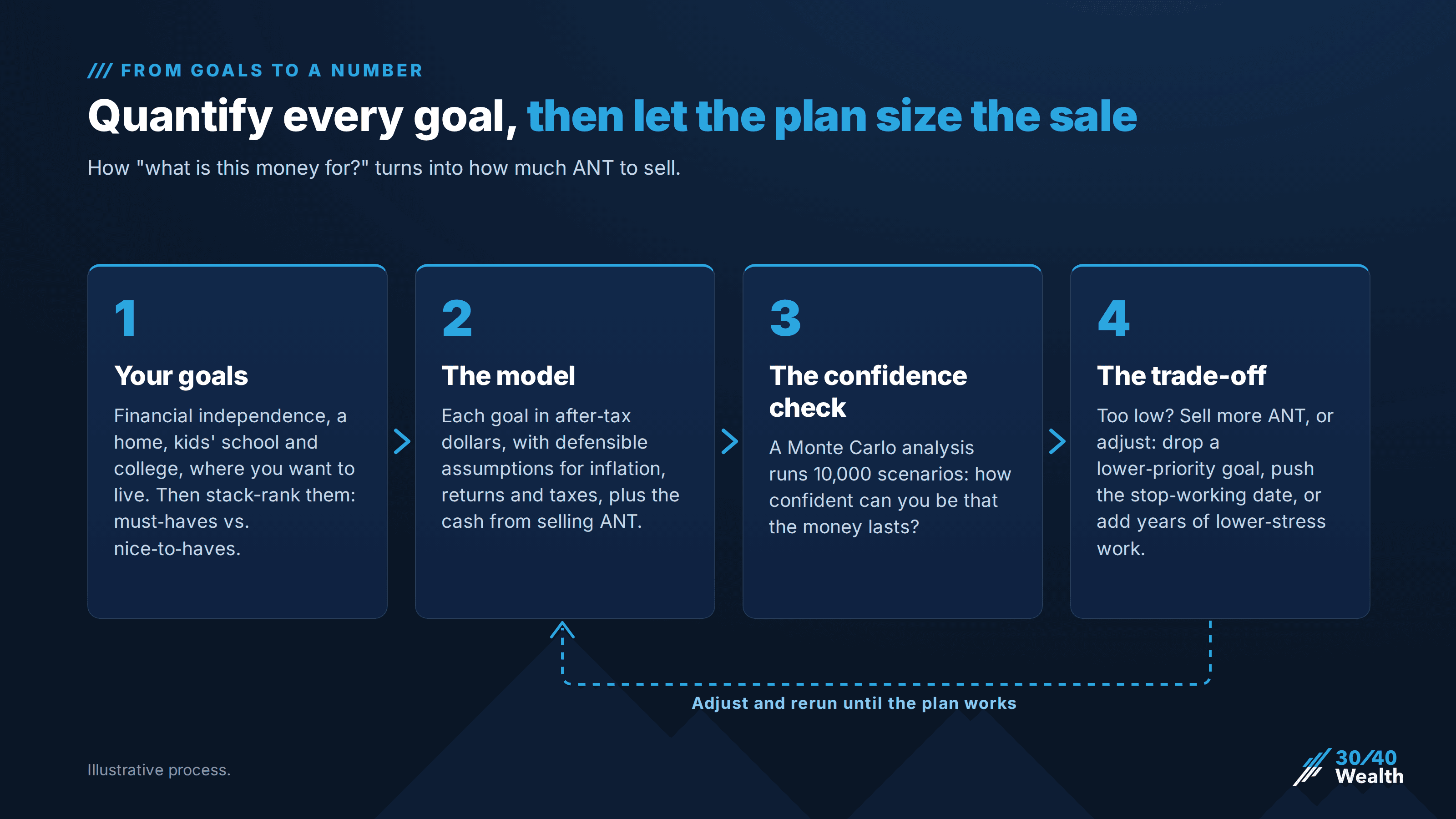
A sample client conversation might sound like this: Your top priority is financial independence. You'd also like to buy a $3 million house in five years (50% down), private school and in-state college for three kids, and a move from California to a lower-tax state in about five years, right around when you call it quits on work.
I've put a number on each of those goals, with defensible assumptions for the things none of us can know: inflation, returns and taxes. Most importantly, the model includes the after-tax cash you'd have from selling ANT.
Then we get a little geeky: a Monte Carlo analysis runs 10,000 scenarios and gives us one useful number, how confident we can be that you won't run out of money if you stop working at a given age.
Then we prioritize. If that number isn't where we want it, we either sell more ANT (if there's more to sell and you're willing to) or adjust inputs like (a) drop a lower-priority goal, (b) push the stop working date out a few years, (c) plan to reduce your spending rate, or (d) instead of outright retiring, swap in some years of a lower income/lower stress job. With every goal quantified, you can see exactly how much ANT you need to sell, and what selling less would cost you. That's a powerful conversation.
Step 2: Split the Position Into Three Buckets
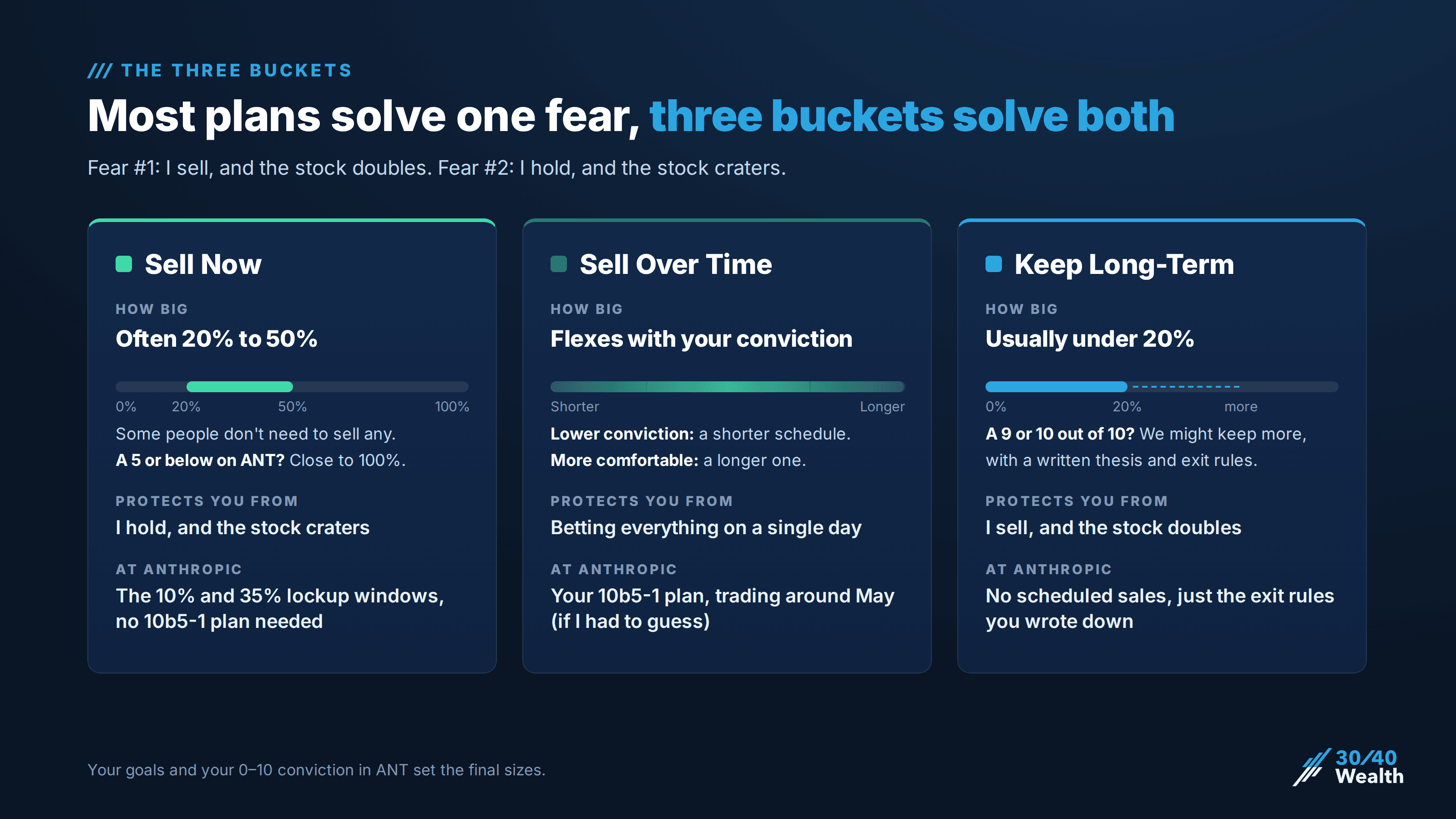
Once you know what the money is for, you can build the structure around it. I split every concentrated position into three buckets, because it solves the two fears that paralyze most people (we call it "regret minimization")
Fear #1: I sell, and the stock doubles.
Fear #2: I hold, and the stock craters.
Most approaches solve one of those fears. The three buckets solve both.
Sell Now. What comes off the table quickly. It funds your near-term goals, cuts your concentration risk and guarantees you sell something. Typical range: 20% to 50% of what you own or have vested today, and more (p to 100%) if you're not bullish on the company (which is perfectly OK!).
Sell Over Time. The bulk of the diversification work, sold on a recurring schedule, typically over two to four years (e.g. sell 2000 shares every month for the next 4 years). This is where most of your future RSU vests end up, too.
Keep Long-Term. What you hold because you genuinely believe in the upside and can afford the risk. I recommend no more than 20% of the position, and only if you feel really strongly about the company as an investment (and ideally have clear exit rules).
Said another way: Sell Now protects you from Fear #2. Keep protects you from Fear #1. Sell Over Time is how you get from one to the other without betting everything on a single day. More on the three buckets here.
At Anthropic, the buckets also line up with how you'll sell. The 10% and 35% window releases are the natural home for Sell Now. Your 10b5-1 plan, which you'll likely adopt in the same window as the 35% release and which won't trade until around May (if I had to guess), is the engine for Sell Over Time.
Step 3: Size Each Bucket
How big each bucket gets shouldn't be a gut call. Three things decide it.
1. How concentrated are you, really? Add up all of your ANT exposure: settled RSU shares, past exercises, vested options (with strikes this low, they move almost dollar for dollar with ANT) and unvested RSUs at today's price. Most people undercount by leaving out the unvested shares. Then divide by your net worth:
Under 25%: you have room to be patient; Sell Now can be smaller.
25% to 50%: meaningfully concentrated; Sell Now should be substantial.
50% to 75%: seriously concentrated; Sell Now should be aggressive.
75% and up (which is most Ants): you're heavily concentrated; Sell Now should ideally be significant
2. What can you actually stomach? If ANT fell 50% within 18 months of the IPO (not a tail event for a newly public, high-multiple stock), what happens to your plan? Can you still buy the house? Leave on your timeline? Sleep at night? If the answer is no, your Keep and Sell Over Time buckets are too big. And remember: losing 75% of your wealth would hurt far more than a 75% gain would help.
3. What do you actually think of ANT as an investment? The two items above are important, but this can trump everything. Here's how I get at it with clients: on a scale of 0 to 10, how do you feel about the company as an investment, and why?
A 5 or below usually means selling quickly. There is no point in taking concentrated risk for a company you dont strongly believe in, so follow the PhD data that says diversifying works out better the vast majority of the time and do so quickly and heavily
A 6 to 8 is where most people land, and where a selling schedule does its best work. Once we appropriately size the Sell Now bucket to achieve your goals, the selling schedule allows you to spread your sales over time (e.g. selling X shares every month for 3 years will get you roughly the average price of ANT over those 3 years; a lot of people feel good about that)
A 9 or 10 means a bigger Keep bucket, with a thesis to match. I wrote about the scale, and why I put nearly every SpaceX client on a schedule instead of one big sale, in this article.
To be clear, a fast, near-complete exit is a perfectly legitimate plan. The data heavily supports you on that one.
How I'd typically advise most clients: if ANT is more than half your net worth (counting unvested shares), size Sell Now toward the top of that 20% to 50% range, and plan to use the first windows you get. Have the Keep bucket at 20% or less, and only with a written thesis you've thought through (and if you can't write the thesis as to why you want to maintain a multi-million dollar long term hold position, you probably shouldn't be doing it).
Step 4: Put It on Paper, Then Stress-Test It
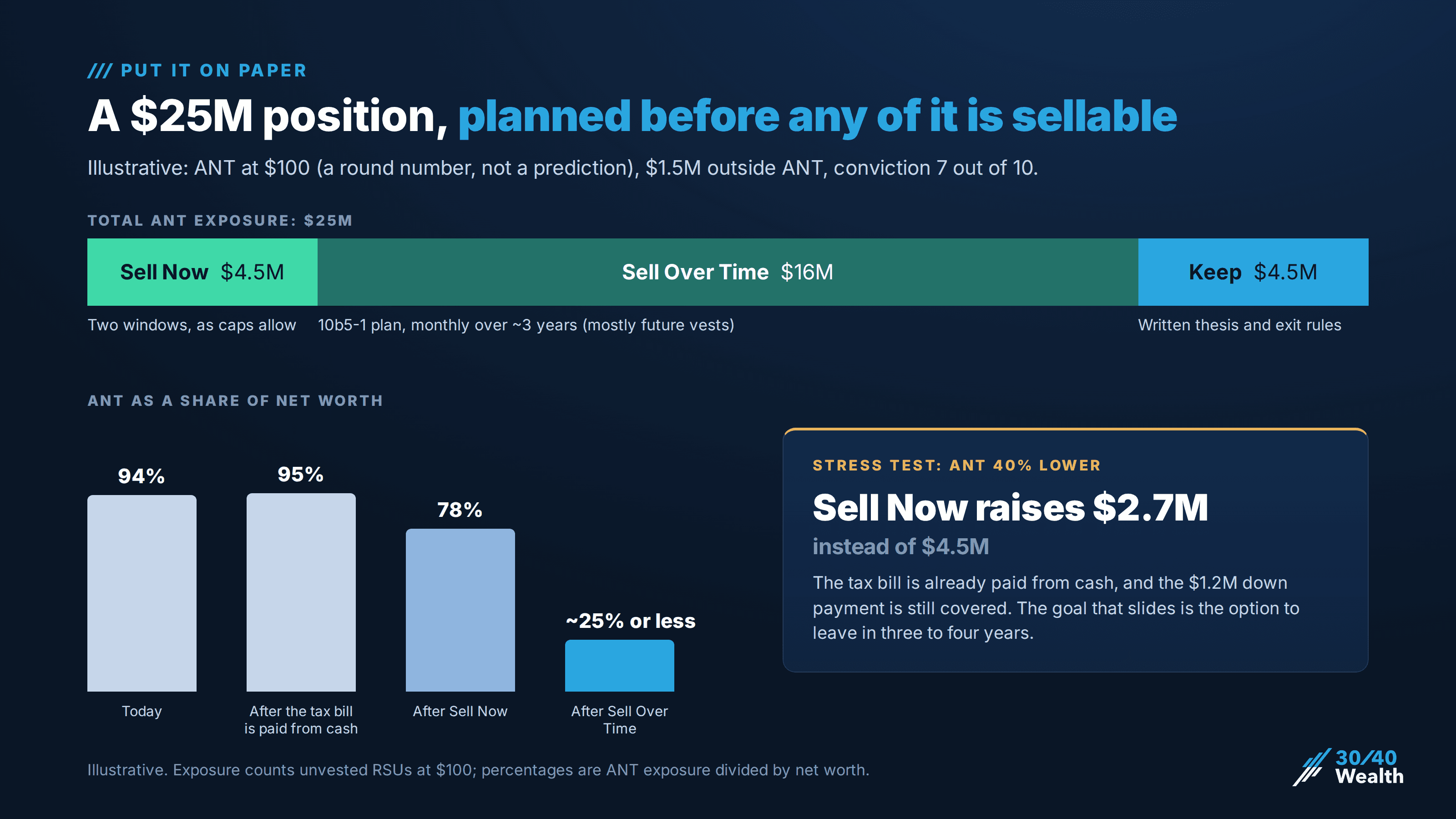
Here's a simplified example. Your numbers will be different, but the structure is the model. (Illustrative, with ANT at $100, a round number, not a prediction.)
A hypothetical Ant:
Total ANT exposure: about $25 million ($11 million owned or vested today, plus $14 million of RSUs vesting over the next three years)
Everything outside ANT: about $1.5 million
ANT as a share of net worth: about 94%
Goals: cover the 2026 federal tax gap (about $145,000) from cash by April; buy a home in about two years ($1.2 million down); have the option to leave in three to four years
Conviction in ANT as an investment: a 7 out of 10
Sell Now: 45,000 shares (about $4.5 million, or roughly 40% of what's vested today). As much of it as the caps allow goes out in the two windows (the 10% IPO release and the 35% release), and whatever a window doesn't allow moves into the plan's first trades in May. It rebuilds the cash used for taxes, funds the down payment with room to spare and takes ANT from about 95% of net worth (after the tax payment) to under 80%.
Keep Long-Term: 45,000 shares (about $4.5 million), just under 20% of total exposure, with a written thesis and exit rules.
Sell Over Time: everything else (about $16 million, mostly future vests), sold monthly through the 10b5-1 plan over about three years. By the end, ANT is roughly a quarter of net worth, or less.
Stress test: before anything sells, run the realistic bad case: ANT is 40% lower by the time your Sell Now shares sell. Here, Sell Now raises about $2.7 million instead of $4.5 million. The tax bill is already paid from cash, and the down payment is still covered. What moves is the "option to leave in three to four years" goal, which slides out. This person decides that's acceptable. If it hadn't been, the fix would be a bigger Sell Now bucket, or electing 37% withholding at the IPO.
Then run your own version. At the lower price, what's your net worth, counting unvested shares? Can you still fund your top three goals? Is the April tax bill covered without counting on ANT? If the plan breaks, change the buckets now, while it's still a decision on paper.
What Your Buckets Decide in the Next Few Weeks
Here's where the plan stops being theoretical. Your buckets answer the near-term decisions for you:
The RSU withholding election (if you're allowed one). Shares held back at settlement are effectively sold at the IPO-day price. That makes a higher election the earliest piece of Sell Now you can get, and it's why I'd typically elect 37% if it's offered.
The limited windows. Sell from your Sell Now bucket. Decide the share count now, so a window announced on short notice isn't a scramble.
Option exercises. Lots of it depends here. Many times this is for higher individuals with higher conviction and planning a long-term hold bucket. But this can also be a smart tax management tool and slot into the Sell Over Time bucket for those with moderate conviction (a 6, 7 or 8 score). 2026 is likely your highest-income year, which makes it an unusually cheap year to exercise ISOs without an AMT impact and start the one-year clock on shares (The options article later this month covers the math.)
The donation match. If you have a pledge or charitable intent, ensure you factor your giving into your buckets as well.
The new ESPP is the one I wouldn't lose sleep over. For most Ants, its impact is a rounding error next to these.
None of these have to be perfect. They do have to point in the same direction as your plan.
The TL;DR Takeaway
You don't need a perfect plan before ANT starts trading. You need two numbers: how much you'd sell in the first window, and how much ANT you're willing to keep for the long haul. Everything else, from your withholding election to the 10b5-1 plan you'll likely sign in February or March, gets built around those two.
If context is helpful -- I've never had a client complain once that we are spending too much time on the analyses for their plan. ANT is a huge financial win and likely a once in a lifetime event. Investing the time planning it out and connecting it to your financial future is really high ROI.
Work with 30/40 Wealth
Have a big equity or tax decision ahead?
We're a fee-only fiduciary for tech employees with a lot of company equity. We build your multi-year plan: when to exercise options, what to sell and when, and how to cut the tax bill. Then we stay with you for the years that follow.
You're likely a fit if:
- You have $2M+ in company equity, including options
- Your next big decision is coming up: an IPO or lockup, a tender offer, exercising options, selling a large position, or leaving your company
- You want ongoing help with all of it: your equity, taxes, investments and the plan that ties them together

Kris Barney, CFA, EA
$750M+ in equity compensation advised
Fees from $12,500 a year, based on the assets we manage
We take on 1–2 new clients a month
Book a 30-minute fit call →Free and no obligation. If we're not the right fit, we'll say so.
See who we work with →If this applies to you, the decisions are worth getting right.
If you're an Anthropic employee approaching liquidity, the sequencing, timing, and structure of just a few decisions can materially change your long-term outcome.
I work with a limited number of clients each year to help navigate these exact decisions before and after liquidity events.
Last updated: October 29, 2026
← Back to Anthropic hub