
I had two conversations this week — different clients, different situations, both circling the SpaceX lockup — that landed on the same underlying problem from two different directions. I want to walk through both, because between them they cover the two most common mental blocks I see with tech clients sitting on a concentrated position for the first time.
Mental Blocker #1: "It's only ever gone up."
The first conversation was with someone who is finding tough to think about selling any of their position. Not because the numbers don't make sense on paper. Not because they don't believe in diversification. Not because they are strong believers in SpaceX as an investment.
But because of the history. SPCX shares have only ever gone up. Every round, every mark, up and to the right. SPCX is what has made them wealthy, and have experienced continual "up and to the right" price increases year over year. Selling something that has never once gone down feels less like risk management and more like a decision you'd be making against the evidence.
Here's what I told them: that's exactly what should have happened in the past -- but not anymore. By definition, a company that goes from Series A to B to C to D to (whatever) and eventually public is one of the small percentage of venture-backed companies that actually works. Success in that world looks like a straight (or parabolic) line up, because that's what success in that world is.
But look at who was setting that price along the way. At each round, you typically have a handful — maybe five — strong VC funds/believers providing the bulk of the capital, with others following their lead. That's not a market. That's an exceedingly small, self-selected sample of the most convinced people in the room, marking their own conviction higher over time. Nobody in that group was shorting the company. Nobody was trading it for reasons that had nothing to do with the business itself.
Once you're publicly traded, everything changes. Trillions of dollars are working every day in the stock market. And billions of people can choose to buy or sell, and some of them can bet against you. What happened in the private markets, however real and however earned, has no direct bearing on how a public, freely-traded stock behaves next. It's not the same game with a new field. It's a different game.
And to be clear, I am not making a call on where SpaceX or any other company's stock price goes from here — I don't do that, and I'd be skeptical of anyone who does.
What I am saying is that the private market price history of your company of "only ever up" is exactly what it should have been in the past. And much more importantly — that while fully acknowledging how mentally difficult it is to not think of it that way — that everything has changed now that your company is publicly traded (and your investment mentality needs to change with it).
I'm also a heavy believer in using data, so let's also do that: If we look at the long-run data on individual public companies, the vast majority of individual stocks underperform a broad market index (e.g. S&P 500) over time. And even worse, individual stocks have significantly more volatility.
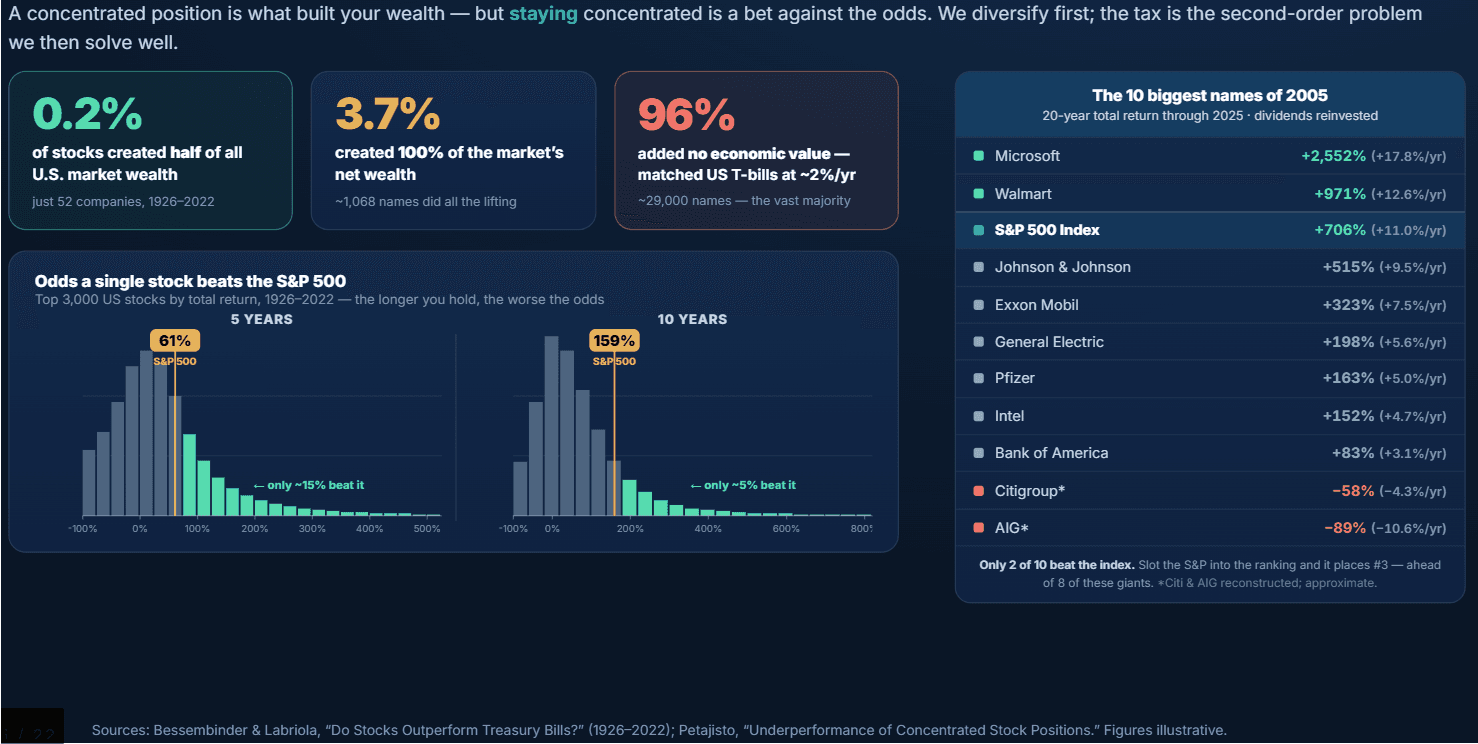
How we worked through it: I didn't try to talk them out of how it felt — that instinct is earned, and it's not irrational given what they've experienced. What we did instead was (1) separate the two mechanisms explicitly: who priced this before, who prices it now and why its so different; (2) review the data on how most individual companies underperform over time; and most importantly (3) tie the wealth from SPCX back to their financial plans/goals and review scenarios + what they were risking if they opted to not meaningfully diversify
Mental Blocker #2: "I didn't plan to do anything"
The second conversation was different on the surface but came from the same place. This was someone I only recently started working with. And their working plan for the lockup release up to that point, had been the all too common plan of "do nothing"...because they were not sure what to do.
I see this one constantly, and it makes complete sense as far as human psychology goes. If you don't know what to do, the instinct is to not do anything until you do. That buys you time to think, to weigh the paths....to feel like you're being careful and prudent rather than reckless.
Here's the reframe I gave them: doing nothing isn't a neutral placeholder while you figure things out. It's a decision — just one you're making by default instead of on purpose. And in this specific situation, that default decision carries meaningfully more risk than the alternative.
Using the same single-stock data detailed above, if you do nothing, you are by definition keeping a significantly higher concentration in a single company than if you took action and diversified into something broad-based.
Said more bluntly: "Waiting to decide" and "staying maximally concentrated" are the same choice (even though they don't feel like it).
To be clear, this isn't blanket advice, and I said the same thing to this client that I'd say to anyone. I have clients who intentionally hold concentrated positions with eyes open. When we land there, it's because they've built a genuine, specific case for why this company is the exception — and they're fully comfortable with the well-above-average risk that comes with it. That's a real, defensible outcome. It's just the exception, arrived at deliberately. It is not supposed to be the default you fall into because making a decision felt harder, was mentally uncomfortable, or you weren't sure what to do.
How we worked through it: We flipped the starting assumption. Instead of "hold until I have a reason to sell," we started from "sell and diversify unless there's a real case for holding" — and then did the work to see whether that case actually exists for them: what the company is worth to them beyond the stock price, how much exposure they already have once you count unvested grants and likely future ones, and what their actual life goals require from this money versus what the position is currently putting at risk. By the end of the conversation, the default "I'm not sure if I want to sell anything" turned into a thoughtful, tax-smart selling plan with notable diversification. And not because I told them what to do, but because we did the work to understand the data, how it effected their personal finances, and framed the risk.
The TL;DR Takeaway
There is a saying in wealth management that "concentrated creates wealth and diversification preserves it." I don't whole-heartedly subscribe to that philosophy (every situation is personal and different); but its far more right than wrong. For personal finances -- human psychology can be an impediment, or even a downright antithesis at times. The two mental blockers detailed above are some of the most common ones I see; and thus extremely important for those with tech wealth to understand and ensure they navigate for themselves correctly.