
Everyone in tech strongly biases towards the same rule about incentive stock options ("ISOs"): exercise, hold, and wait out the clock — two years from grant, one year from exercise — so your gain is taxed as a long-term capital gain instead of ordinary income. That's the qualifying disposition. Chase the lower long-term capital gains tax rate.
Excepting that I don't always agree with the above (as it requires taking company risk for a year and juggling AMT)....but if you live in the state of Washington, the qualifying disposition route can actually cost you MORE.
To be clear, this isn't a blanket rule and the wrong takeaway is expensive in both directions. But for a specific group of people in WA — specifically those with ISO grants in the millions of dollars — the ISO qualifying-disposition playbook actually flips. The math stops supporting it, and you end up fronting cash and juggling AMT to earn yourself a bigger tax bill.
The WA state quirk that changes everything
Washington has no income tax. It doesn't tax short-term capital gains. It doesn't tax your RSU vesting, your NSO exercise, or your wages (at least not yet).
There is exactly one thing Washington (currently) reaches out and taxes: long-term capital gains. Here's how the graduated tax bracket in WA generally looks:
The first ~$280k of long-term gains in WA each year: 0% tax
The next ~$1 million: 7% tax
Everything above that: 9.9%
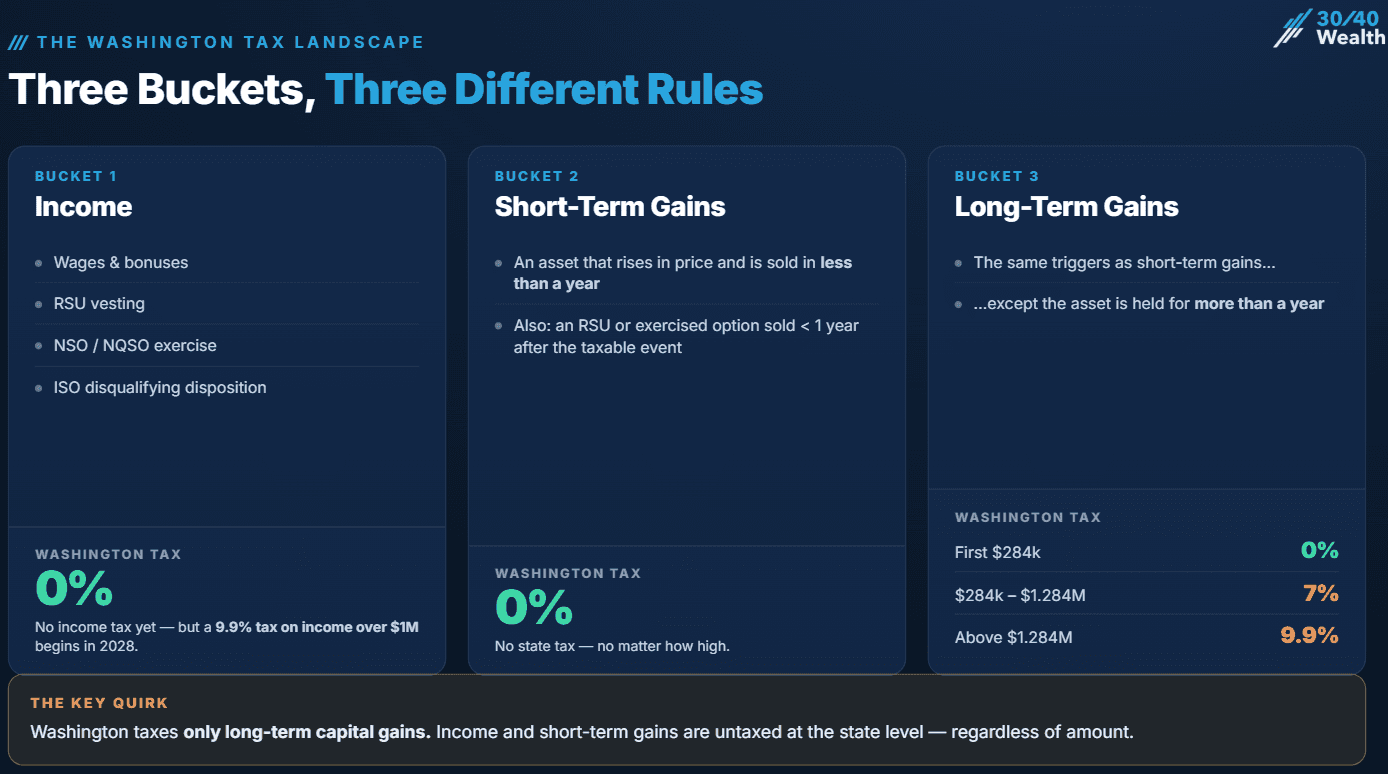
Now sit with what that means for an ISO. A qualifying disposition converts your gain into a long-term capital gain — the one and only bucket Washington taxes. The reward for clearing every hurdle an ISO requires is that you get hit with the single tax your state actually collects.
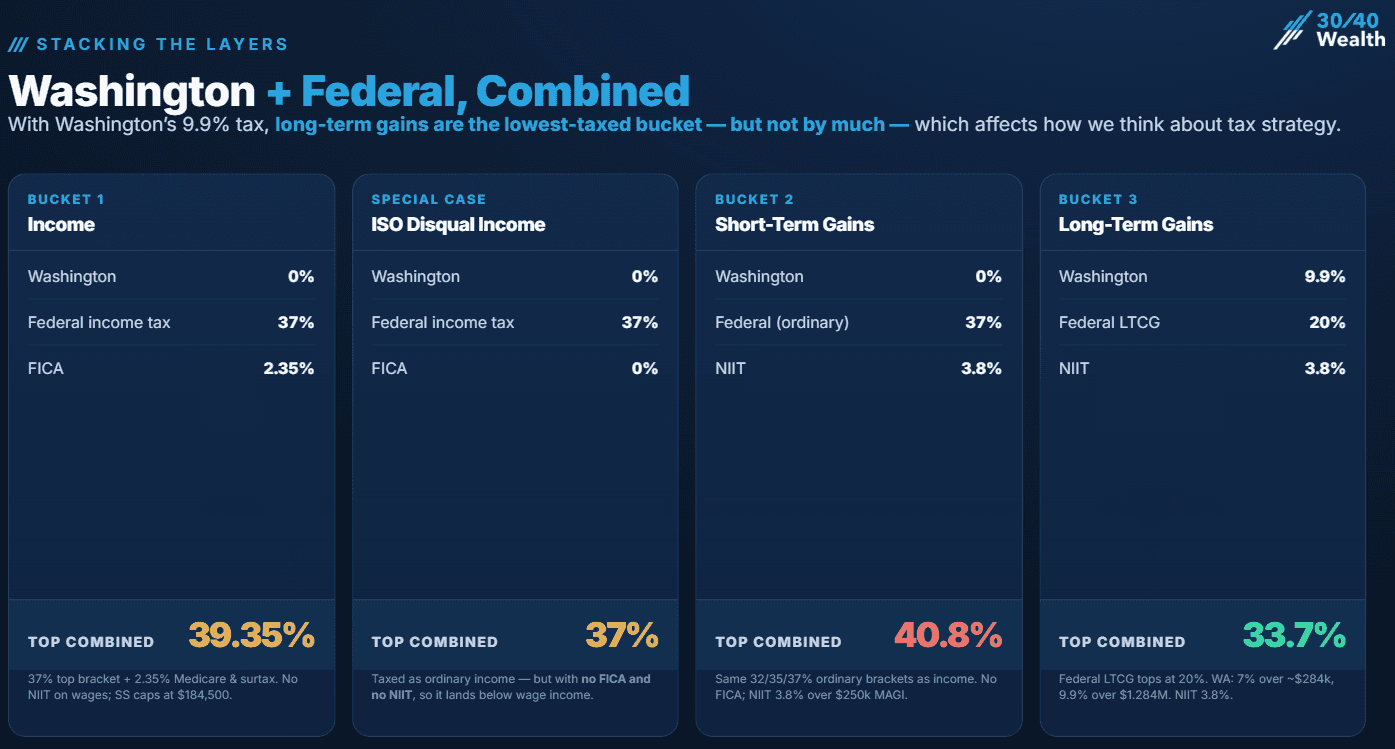
An ISO disqualifying disposition does the opposite. It's taxed as ordinary income — and ordinary income in Washington is (currently) taxed at zero. There's even a bonus quirk in your favor: income from an ISO disqualifying disposition isn't subject to FICA, so it lands below your regular wages on the federal side too.
Combined Federal/IRS and Washington State Tax Rates
What you care about is your total taxation. And when you consider the combined Federal and WA state taxes together by different types of income or capital gains, there is not a huge gap between (i) an ISO disqualifying disposition, and (ii) a qualifying disposition taxed as a long-term capital gain (if you are at the highest 9.9% bracket).
And don't forget about AMT
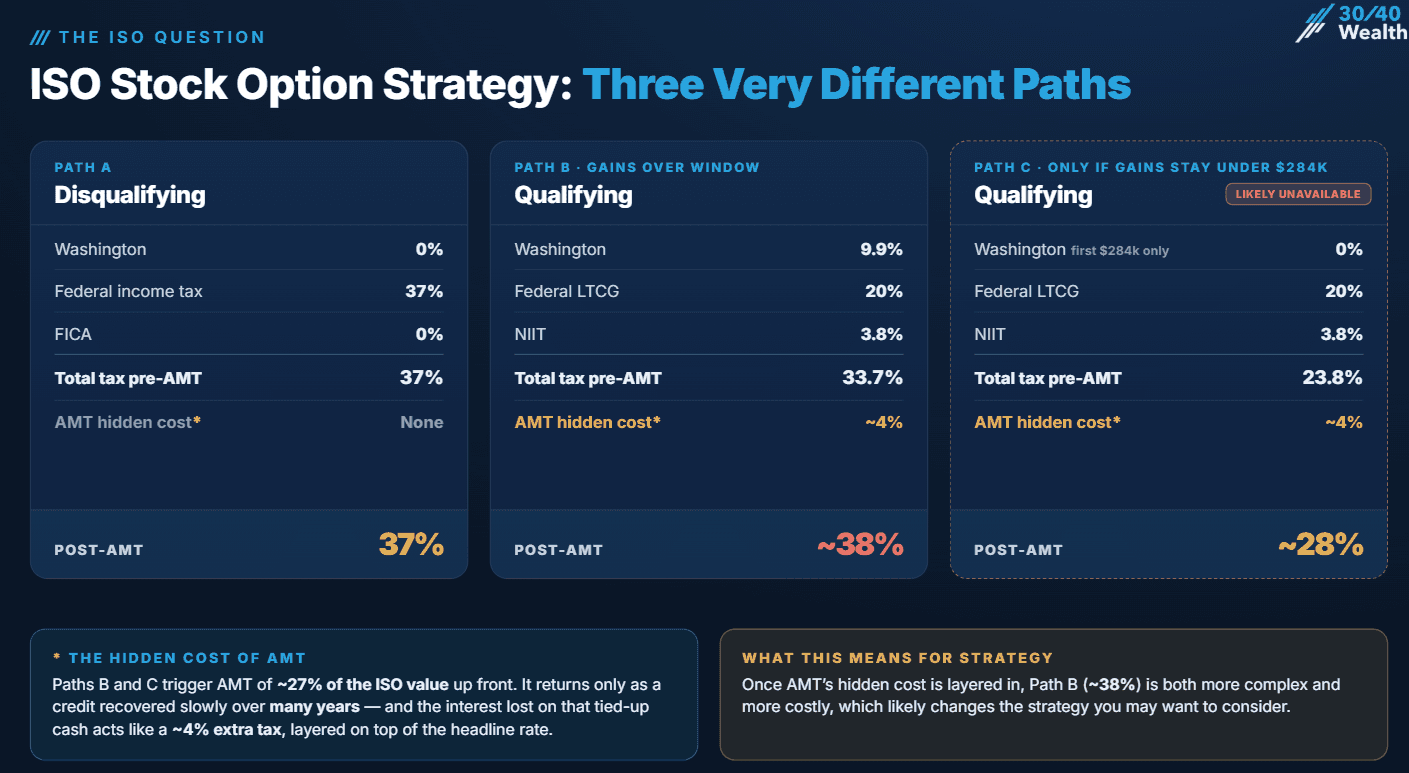
Adding to the challenges above of very similar tax rates if you live in WA, you also need to handle AMT if you aim for a qualifying disposition. It's a bit of a gnarly beast as to how much you pay, how you can recoup it, and how long it takes. If I assume a reasonably good outcome, back of envelope math is that having to navigate AMT results in around an incremental 4% cost due to the AMT credit at the IRS acting like an interest free loan (when you otherwise would be earning income on it). If you layer in that additional AMT cost, the ISO DISQUALIFYING disposition can actually be MORE favorable than the Qualifying one (without any of the hassle). Said another way: you did more work, and took more risk, to get less after tax and AMT costs:
Does it Ever Make Sense if You Live in Washington (Yes it does)
Like all things in personal finance and tax strategy -- this is personal. As detailed above, there are situations where it doesn't make sense. And as detailed below, there are situations where it can financially pencil.
GENERALLY MAKES SENSE: Your annual long-term gains stay under ~$280k. If your plan will keep your realized long-term gains beneath Washington's standard deduction of ~$280k, the WA taxation on the gains will be 0%. In this situation, an ISO qualifying disposition generally makes sense to pursue tax-wise (as long as you're OK with the 1 year hold requirement and the price risk that comes with it).
GENERALLY MAKES SENSE: You plan to relocate to a low/no tax state before you sell. The 9.9% only bites if you're a Washington resident with large capital gains when you sell. If you're planning to relocate to a low or no-income-tax state prior to when you'll sell— that 9.9% will never touch you. Which puts you in the same situation as the above: an ISO qualifying disposition generally makes sense to pursue tax-wise (as long as you're OK with the 1 year hold requirement and the price risk that comes with it).
DEBATABLY MAKES SENSE: You'll be in the 7% tax bracket. The tax rate + AMT cost toll combined here would likely be moderately lower. If you strongly believe in your company stock as an investment, an ISO qualifying disposition could be worthwhile. Otherwise, the 1 year holding period and AMT hassle likely aren't worth it for a couple percentage points.
And there's more....Things Change in 2028
There's a timing element worth flagging. Washington has enacted a new 9.9% tax on income over $1M, effective 2028. Today — and through 2027 — ordinary income is still untaxed at the state level, which is part of what makes the disqualifying route so clean. That edge narrows for large ISO disqualifying dispositions once the income tax kicks in.
What Should You Do?
Personal decision based on your circumstances. I'm not here to tell you to always disqualify. Rather, this article is here to detail the math behind why the typical default of — "hold the ISO for the qualifying disposition, it's always cheaper" — isn't necessarily true if you are in WA. And to ensure you take that into consideration when developing your strategy.