Part 3 of 8 — Anthropic Equity Decision System
When Can an Ant Actually Sell? Windows First, Then a 10b5-1 Plan
The lockup comes off in three steps, and the first two sell in short windows — here's the real first-year calendar for Anthropic employees.
When can I sell during the lockup, and how much?
How is my cap calculated, and what counts against it?
How do the 5-day windows and the 60-day cooling-off actually work?
What should I have ready before each window?
Here's the question I hear from almost every employee once an IPO becomes real: "When can I actually sell?"
At most companies, the answer is basically one date: when the lockup expires. At Anthropic, it comes in two phases, and they work very differently:
During the lockup, you sell in two short windows. The first opens the day ANT starts trading. The second opens just after Anthropic's first earnings release as a public company. Together they let you sell up to 10%, and then up to another 35% with no 10b5-1 plan needed.
After the lockup, you sell through a 10b5-1 plan. Everything else, including every share that vests after the IPO, runs through a plan you sign months before it trades.
Said another way: your first sales happen in two short windows, and everything after that runs through a plan you have to sign well in advance. Neither one rewards showing up unprepared.
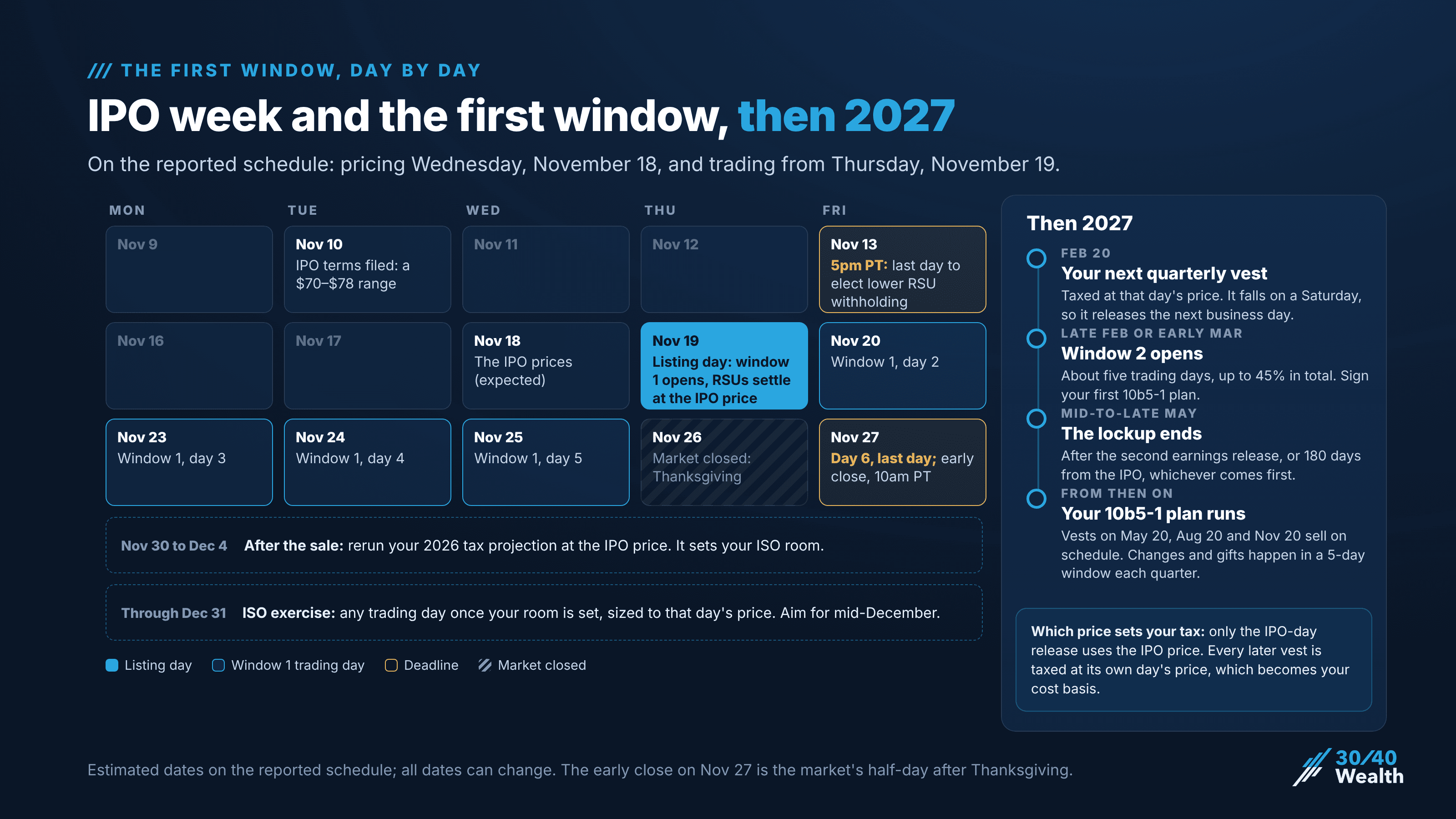
Two ground rules. First, the calendar: Anthropic's updated filing sets a price range of $70 to $78 a share (this can change prior to the final IPO price), and the IPO is reportedly set to price on Wednesday, November 18, with trading starting Thursday, November 19. If that slips, shift the calendar; the framework is the same. Second, this covers the lockup that applies to employees, and to former employees, who follow the same release schedule. Founders and the largest shareholders have a longer one that isn't covered here.
The Lockup Comes Off in Three Steps
Here's how it works on a mid-to-late November IPO:
The first window: up to 10%, no 10b5-1 plan needed. It opens the day ANT starts trading (expected Thursday, November 19) and stays open about six trading days, which runs through Thanksgiving week.
The second window: an additional 35% (45% in total), no 10b5-1 plan needed. It opens two full trading days after the first earnings release (likely late February or early March 2027) and stays open about five trading days.
The lockup ends: the rest, through a 10b5-1 plan. That's the earlier of two full trading days after the second earnings release, or day 180 (mid-to-late May 2027).
The exact window dates aren't set yet, and you'll get notice before each one. The final prospectus is what counts.
How Your Cap Is Calculated
The percentages are not as they seem, so lets walk through them:
The cap is based on everything you hold (e.g. includes unvested), not just what's vested. It's a percentage of all your Anthropic equity (shares plus every award, vested or not), counted as of the last day of the month before the IPO (October 31). That one count sets your cap for both windows.
But only vested shares can actually be sold. If much of your equity is still unvested, you may not have enough vested shares to use your whole cap. Shares that vest before or during a window can be sold in it.
Unused cap carries forward. Whatever you don't use in the first window rolls into the second.
Selling isn't the only thing that counts. Donating shares and transferring them (including to a trust or a family member for estate planning) use up your cap too. Shares withheld to cover the tax on your RSUs don't. Neither does exercising options with cash, unless you then sell the shares. In a cashless exercise, the shares that get sold count. And if you want to give ANT shares and deduct them in 2026, the first window is your only chance this year.
Each account has its own cap, including a trust account, but together they can't go past the overall limit.
An illustrative example: say you held 400,000 shares and awards, vested and unvested, at the end of October. Your cap is 40,000 shares in the first window and 180,000 in total by the end of the second. If you sell 15,000 in the first window, you can sell up to 165,000 in the second, as long as you have that many vested shares. At $74, the middle of the price range, that first-window cap alone is worth ~$3 million.
One more detail for a small group of Ants: shares from an option exercise in the year before the IPO, or shares from an acquisition, can carry extra holding periods before they can be donated, transferred or put into a plan, and acquisition shares can't be sold before the second window. If that's you, expect to hear from the company directly.
Phase 1: The Two Windows
A few things worth knowing before the first one opens:
The first window is also your first RSU settlement. The same day your RSUs settle (and create your 2026 tax bill), they become available for trading in the window. Your RSU income, and the cost basis of those shares, are set at the IPO price, before trading starts, and shares are held back that day to cover the tax.
Selling is optional, and you can sell more than once. Nothing is lost if you sit a window out, because the cap carries forward. Within a window, you can place several sales, up to your cap. And during the window, you can sell as many times as you want. Using the example above of 40,000 shares available, you could sell those all on day one, spread them over 5 days at 8,000 apiece, or sell twice a day over those 5 days at 4,000 each time. It's your choice as long as you sell within the window.
Cash takes a few days. Trades settle the next business day, then the transfer to your bank takes a few more. Plan for that if a sale is funding something with a deadline.
What isn't set yet is the exact dates. You'll get notice, but things tend to happen fast in an IPO, and a window that opens on IPO day leaves little time to think. If the first time you think about how much to sell is the day a window opens, you'll be deciding under pressure, with the stock moving and everyone around you doing the same math.
How I'd typically advise most clients: treat the two windows as your Sell Now bucket. Know your cap and your vested share count, and have the number of shares decided before the first window opens, so that when it does, you just execute. And don't let your April tax bill depend on the second window landing before April 15.
The how-much-to-sell article earlier in this series is about sizing that bucket.
Phase 2: After the Lockup, Every Sale Runs Through a 10b5-1 Plan
At most public companies, employees can buy and sell their own shares during an open trading window a few weeks after each earnings release. Only executives and a handful of others need a 10b5-1 plan.
Anthropic flipped that. Because the company shares so much information internally, nearly every employee is treated like an executive for trading purposes. As a current employee, you can't sell outside the two windows during the lockup, and after it ends, you can only sell through a 10b5-1 plan.
A 10b5-1 plan is a trading schedule you set in advance: how many shares, when, and at what prices. Once it's active, it trades automatically. Here's how it works at Anthropic:
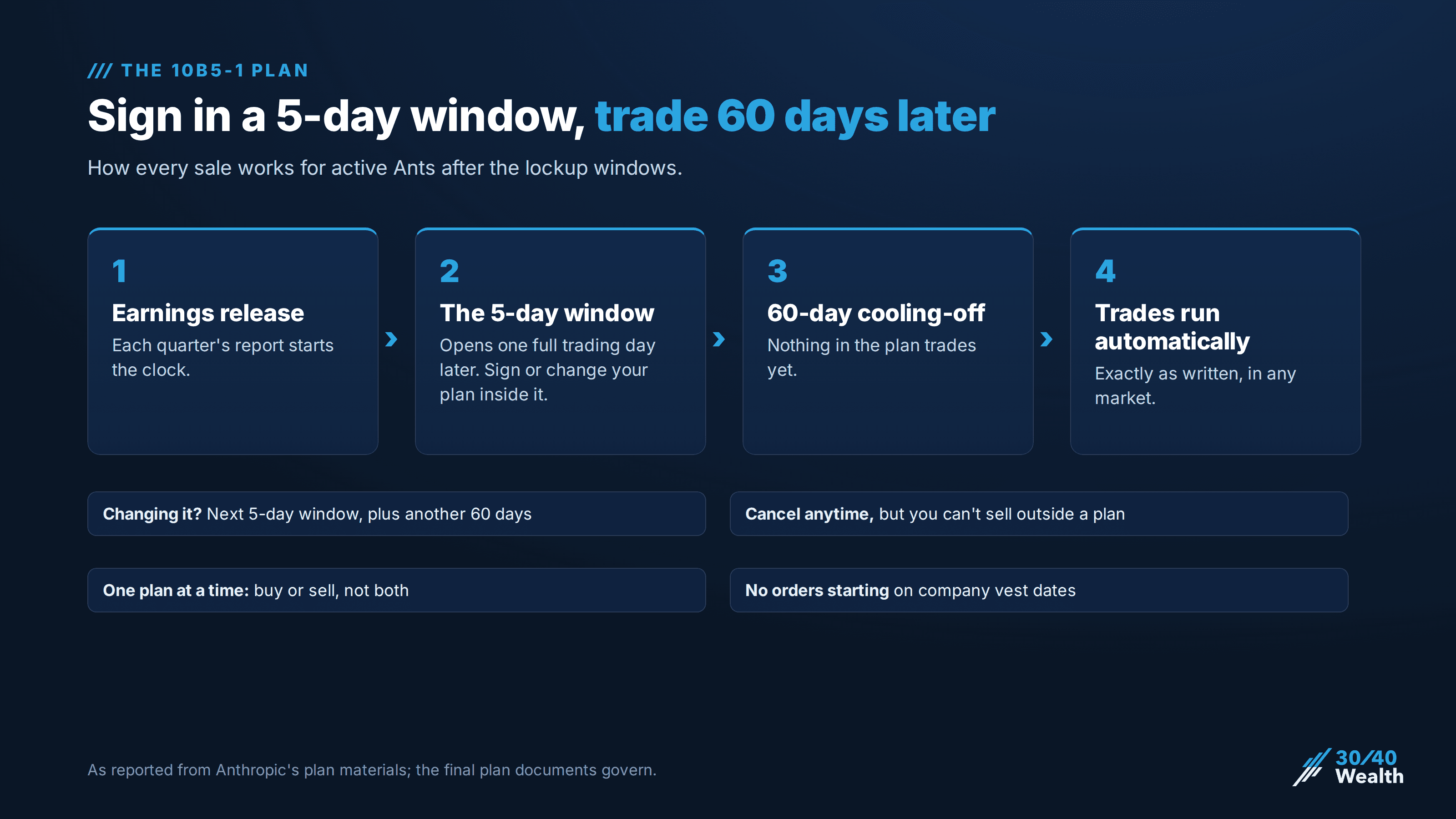
You can only adopt (or change) a plan during a 5-day window after each quarterly earnings release. Your first chance is the window after the first earnings release, the same week the second limited window opens.
Nothing trades via the 10b5-1 until 60 days after the window closes, and never before the lockup ends. So even a plan signed at the first chance won't sell anything until mid-to-late May.
Every change restarts the clock. You can cancel anytime, but you can only amend during a window, and an amendment works like a brand-new plan: another 60 days before anything trades.
One plan at a time, and it can buy or sell, not both.
No sales scheduled on a company RSU vest date (February 20, May 20, August 20 or November 20). Aim for the next couple days after if you want to sell these.
No plan needed if exercising options with cash. You can do that anytime after the IPO, including during the lockup.
If you've left Anthropic, the two windows and the caps still apply to you during the lockup. After it ends, former employees can generally sell on any trading day, with no plan.
Said another way: after the lockup, there's no "I'll sell when the window opens." There's only "I'll sell when the plan I signed months ago says so." Every 5-day window you miss pushes your next possible plan sale out by a quarter.
Put the Two Phases Together
This is where it clicks. The second limited window opens in the same week as the first 5-day window to sign a plan. That one week is your last chance to sell before the lockup ends, and your first chance to sign the plan that sells everything after it.
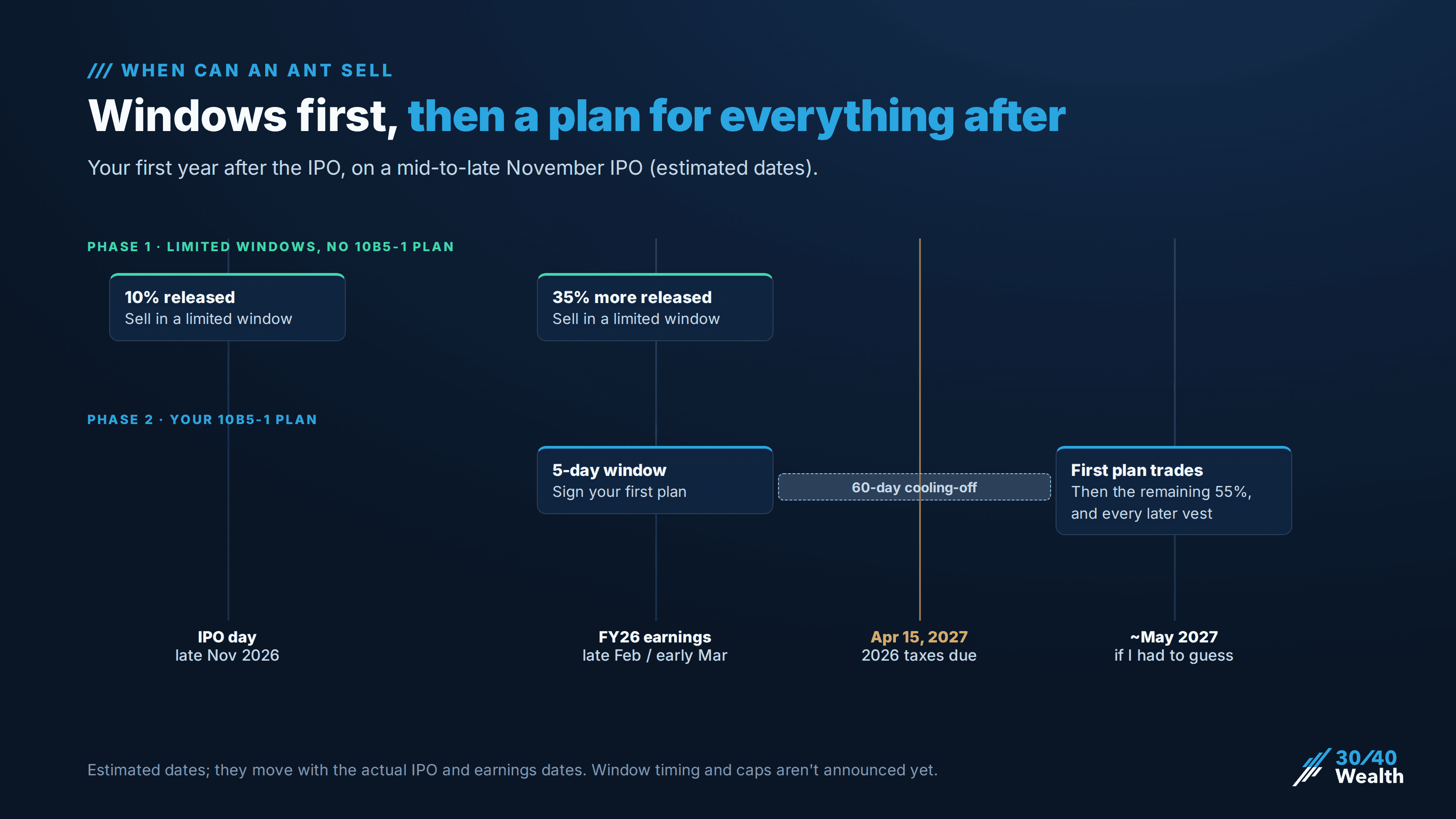
Here's the first year at a glance (estimated dates, on a mid-to-late November IPO):
IPO day (expected Thursday, November 19): the first window opens and your RSUs settle. You can sell up to 10% of your equity, no plan needed.
December 2026 to February 2027: nothing new. No sales until the second window.
Late February or early March 2027: the second window opens, along with the first 5-day plan window. You can sell up to 45% in total with no plan, and sign your plan.
April 15, 2027: your 2026 taxes are due.
Mid-to-late May 2027: the lockup ends, and your plan's first trades go through.
June 2027 onward: everything is released. You sell through your plan, with a 5-day window each quarter to change it.
One Tax Detail Worth Knowing Now
The shares you receive at the IPO have a cost basis equal to the IPO price, the price set before trading starts. If you sell them before you've held them a year (roughly November 2027), any gain above the IPO price is short-term, taxed at the same rates as wages (or if at a loss, it creates a capital loss). So if ANT opens well above the IPO price and you sell in the first window, part of that sale is a short-term gain. If ANT is lower when you sell, the sale may generate a capital loss instead. Either way, which shares you sell, and when, starts to matter in 2027. The planned 2027 capital gains article in January goes deeper.
Your Decisions And What You Control
Reading all of this, it might feel like the timeline is entirely out of your hands. While there are limited windows, Anthropic's setup is more generous than most IPO'ing companies (typically employees can't sell anything until the lockup ends 180 days later). You have two windows to sell, the first starting the day ANT trades, with caps sized on all of your total equity, not just what's vested.
What you don't control is the IPO date, when earnings land, or exactly when the windows open. But here's what you do control:
Whether you know your cap, and how many of your shares are actually vested, before the first window opens
Whether you've decided how many shares you'd sell in each window, and how you want to sell during that window (all at once, spread over multiple days, etc.)
Whether your withholding is set by November 13, and the cash for the rest of your 2026 tax bill exists without needing a window
Whether your plan is finished
before
the first 5-day plan window opens, not drafted during it
Here's the question you should ask yourself: If the first window opened tomorrow, could you write down how many shares you'd sell? And if the 5-day 10b5-1 plan submission window opened tomorrow, could you write down your plan: how much, how often, from which lots? If not, that's your work right now (for the initial 10% selling window), and for between now and February (for the second selling window and the 10b5-1 plan submission).
Work with 30/40 Wealth
Have a big equity or tax decision ahead?
We're a fee-only fiduciary for tech employees with a lot of company equity. We build your multi-year plan: when to exercise options, what to sell and when, and how to cut the tax bill. Then we stay with you for the years that follow.
You're likely a fit if:
- You have $2M+ in company equity, including options
- Your next big decision is coming up: an IPO or lockup, a tender offer, exercising options, selling a large position, or leaving your company
- You want ongoing help with all of it: your equity, taxes, investments and the plan that ties them together

Kris Barney, CFA, EA
$750M+ in equity compensation advised
Fees from $12,500 a year, based on the assets we manage
We take on 1–2 new clients a month
Book a 30-minute fit call →Free and no obligation. If we're not the right fit, we'll say so.
See who we work with →If this applies to you, the decisions are worth getting right.
If you're an Anthropic employee approaching liquidity, the sequencing, timing, and structure of just a few decisions can materially change your long-term outcome.
I work with a limited number of clients each year to help navigate these exact decisions before and after liquidity events.
Last updated: November 11, 2026
← Back to Anthropic hub