Tax Strategies
QSBS "Packing" (Invest with Property)
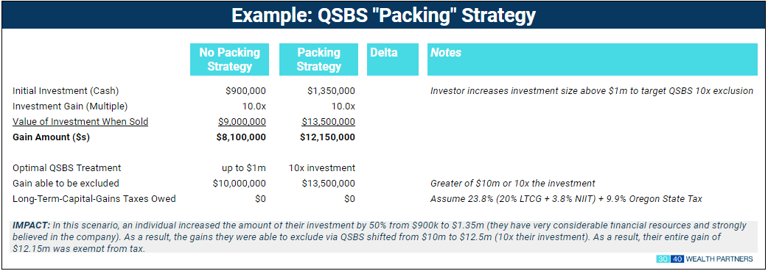
Investing more than $1mm in a QSBS eligible company enables a QSBS exclusion above $10mm via the 10x rule. Property can also be invested (vs. cash), which increases strategic options.
Strategy Overview
Per IRS rules, a taxpayer can exclude up to 100% of their capital gains from the sale of QSBS, subject to certain limits: the greater of (1) $10 million or (2) 10 times their investment.
Most individuals either have gains below $10 million, or utilize a QSBS Stacking Strategy; but an alternate strategy is to make an investment in excess of $1 million (which shifts the QSBS exclusion to 10x the investment). The investment (called "packing") can be made with cash, and/or property, which also enables additional strategic investment planning opportunities.
Tax Details
Under the QSBS rules in Section 1202 of the Internal Revenue Code, a taxpayer can exclude up to 100% of their capital gains from the sale of QSBS, subject to certain limits. The primary limit is a cap on the total amount of gain that can be excluded; (1) the greater of $10 million or (2) 10 times the taxpayer's basis in the stock (i.e. their investment). Importantly, an investment can be made with cash, and/or property.
One strategy that can be readily employed is to make a cash investment of more than $1 million. For example, an investment of $4 million would be allowed to exclude $40 million of capital gains via QSBS.
A second approach is to invest via property, which has a wide variety of strategic optionality. For example, an investment in a company of (1) a business, (2) real estate, and/or (3) Intellectual Property would all be perfectly valid assets to use to invest in a company. Some business owners/founders may start a business (e.g. StarterCo), build it a bit, and then use its assets/value as an investment into a second business (e.g. FinalCo). If the appraised value of the StarterCo was above $1 million, this enables them to expand the QSBS exclusions via the 10 times their investment rule. Additionally, these property assets are illiquid, and their value is frequently determined by an appraisal -> which is more subjective (and at times manipulatable) vs. a cash investment.
Key Benefits
Save on taxes by expanding the QSBS tax exclusion amount. By using a "packing" strategy, one can expand the total QSBS exclusion amount beyond $10 million.
Key Considerations/Flags
High risk of investment loss. If you're investing in startups, there is a high risk of loss (as evidenced by this data). Investing more simply for tax reasons doesn't change the risk of the investment, and for many individuals is inappropriate.
Cost and complexity of implementation (if investing property). Contributing property to a company as part of your investment has added costs (their party valuation), potential tax impacts (capital gain from "sale" to the new company), and potentially higher risk (third-party valuation error).
Strategy: When to Consider This and When to Avoid It
🟢 When to Consider This Strategy:
If you strongly believe in a company/investment and have considerable financial resources. Startup investments have high risk of loss, and the investment considerations should be your first priority. But if you have considerable financial resources, an investment above $1 million may be appropriate in your situation.
If you own property that would have strategic value to a company you want to invest in. The ability to contribute property as part (or all) of your investment can be an attractive option in some scenarios.
🔴 When to Not Use This Strategy:
If your gains will be under $10 million. For the vast majority of individuals with QSBS, the realized gains will be less than $10 million. In these circumstances, there is no need to consider a QSBS packing strategy.
If you are not comfortable with the costs or complexity. If you're not comfortable with the size of your investment, or the added complexity of contributing property, then it likely isn't the best choice.
If you're increasing your desired investment size primarily for tax/QSBS purposes. Startup investments have high risk of loss, and the investment considerations should be your first priority.
Example
Work with 30/40 Wealth
Have a big equity or tax decision ahead?
We're a fee-only fiduciary for tech employees with a lot of company equity. We build your multi-year plan: when to exercise options, what to sell and when, and how to cut the tax bill. Then we stay with you for the years that follow.
You're likely a fit if:
- You have $2M+ in company equity, including options
- Your next big decision is coming up: an IPO or lockup, a tender offer, exercising options, selling a large position, or leaving your company
- You want ongoing help with all of it: your equity, taxes, investments and the plan that ties them together

Kris Barney, CFA, EA
$750M+ in equity compensation advised
Fees from $12,500 a year, based on the assets we manage
We take on 1–2 new clients a month
Book a 30-minute fit call →Free and no obligation. If we're not the right fit, we'll say so.
See who we work with →Most Similar
Selected by content similarity, not just shared category.
Next Step
Want this applied to your situation?
A 30-minute consult will tell you whether the framework in this article applies cleanly to your equity package — and if so, what the next three moves are. No pitch.