Tax Strategies
Early Exercise (via 83(b) Election)
Strategy Overview
Filing an 83(b) election when you receive an NSO grant (or soon after) can shift all future taxes on gains from ordinary income to capital gains rates.
Tax Details
With an 83(b) election, you exercise your options and purchase the shares early, frequently just after the grant date, when the fair market value (FMV) equals the strike price. This means there is often no taxable bargain element and no upfront tax payment.
Note: You still must pay the strike price to exercise the options and acquire the shares, which may require putting a significant amount of capital at risk.
The benefit is all future appreciation is taxed as capital gains rather than ordinary income when you eventually sell the shares. To get long-term capital gains treatment, you must hold for over 1 year from the exercise date.
Key Benefits
Pay income taxes (if any) at a lower share value.
Starts long-term capital gains holding period sooner, as well as start the clock on the 5-year QSBS holding requirement.
Can significantly reduce future tax liability if share value increases.
Key Considerations/Flags
Your company/grant has to allow early exercise. Not all companies and/or grants allow this
You very likely won't get the funds back if the company performs poorly. Any taxes paid cannot be recouped. Additionally, if you depart early, the FMV at which your shares are (likely) repurchased may be a much lower price
You typically must opt for and file an 83(b) election within 30 days of grant or early exercise, though in practice there are frequently exceptions and flexibility to this that allow you to do it after 30 days.
Strategy: When to Consider This and When to Avoid It
🟢 When to Consider This Strategy:
The company is in a very early stage and the cash outlay is modest. For example, if you were granted 100,000 NSOs (representing 0.5% of the company) with a strike price of $0.02, the $2,000 outlay to buy all the shares likely represents an attractive risk/reward should the company do well.
You expect to be at the company long-term, are highly confident in its business prospects and potential for increase in share value, and have the capital to exercise the option.
🔴 When to Not Use This Strategy:
The company does not allow early exercise to file 83(b).
You are uncertain of the company's future prospects or your tenure there. The taxes you paid cannot be recouped, and the price any unvested shares are repurchased at could be much lower.
The 409a valuation is high currently and would result in a large tax payment upfront. This isn't always an auto-no (as you could still reduce your taxes on additional price gains), but it makes the decisions harder.
Exercising NSOs is foremost an investment decision. Tax optimization is important, but should be your secondary consideration. The upfront taxes are unrecoverable if the share value declines.
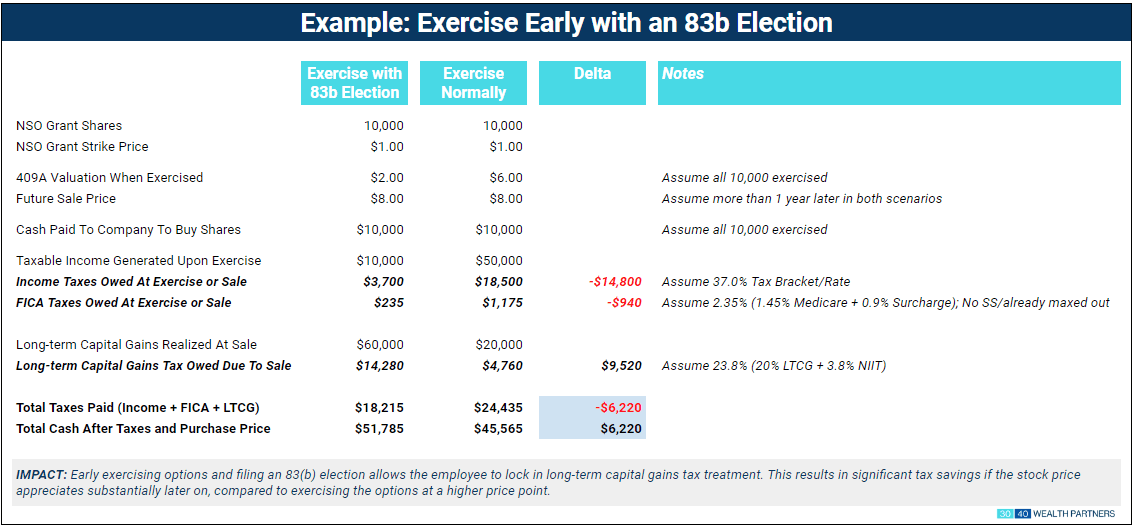
Example
Work with 30/40 Wealth
Have a big equity or tax decision ahead?
We're a fee-only fiduciary for tech employees with a lot of company equity. We build your multi-year plan: when to exercise options, what to sell and when, and how to cut the tax bill. Then we stay with you for the years that follow.
You're likely a fit if:
- You have $2M+ in company equity, including options
- Your next big decision is coming up: an IPO or lockup, a tender offer, exercising options, selling a large position, or leaving your company
- You want ongoing help with all of it: your equity, taxes, investments and the plan that ties them together

Kris Barney, CFA, EA
$750M+ in equity compensation advised
Fees from $12,500 a year, based on the assets we manage
We take on 1–2 new clients a month
Book a 30-minute fit call →Free and no obligation. If we're not the right fit, we'll say so.
See who we work with →Most Similar
Selected by content similarity, not just shared category.
Next Step
Want this applied to your situation?
A 30-minute consult will tell you whether the framework in this article applies cleanly to your equity package — and if so, what the next three moves are. No pitch.