
Tax Strategies
Manage Your Income Tax Bracket
Strategically time income and maximize deductions to manage tax brackets and minimize overall liability
Strategy Overview
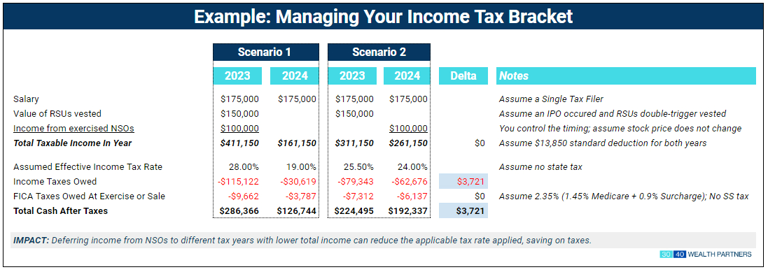
Managing your income tax bracket involves carefully timing your income and deductions (to the extent you can control them) to avoid jumping into a higher marginal tax bracket. By understanding the tax bracket thresholds and where your taxable income will likely fall, you may be able to shift income to lower tax years and/or increase deductions in higher income years.
Tax Details
The federal income tax system has graduated tax brackets where tax rates increase at higher levels of taxable income; most states have graduated tax brackets as well. Generally, you'll have minimal or no control over when you will receive your income (e.g. your salary is paid every two weeks; period).
But with NSOs and disqualifying ISOs, you control the timing of when you exercise and create a taxable event. By understanding your expected tax bracket this year, next year, etc. -> you may be able to strategically time the exercise to a more optimal year. Combined with maximizing your income tax deductions in higher years, this tax bracket management strategy can lead to substantial tax savings overall when exercising stock options.
Key Benefits
Avoid higher marginal tax rates due to spikes in income. Careful timing of income from stock options and other sources can prevent your taxable income from jumping into a bracket with rates that are 5-10% higher. This can result in thousands in tax savings.
Potentially lower overall taxes. Smoothing income across years can result in paying a lower effective tax rate vs. having all income condensed into one year.
Key Considerations/Flags
Investment risk. If you delay exercising an NSO or ISO, you'll likely still have investment exposure/risk to the underlying company's stock price (and potential declines in value).
Limits on what income is controllable. Typically only a few types of income are able to be shifted (e.g. NSOs). Most income is fixed.
Strategy: When to Consider This and When to Avoid It
🟢 When to Consider This Strategy:
You are already close to the threshold of jumping into a much higher bracket. Even a small spike in income could push you over.
You have some control over the timing of income from sources like stock options.
You expect a large stock compensation event, bonus, or other windfall in a certain year.
You're comfortable with the investment risk associated with deferring the exercise to the future.
🔴 When to Not Use This Strategy:
You're not comfortable with (or concerned by) the investment risk associated with deferring the exercise to the future.
You probably don't want to overly fixate on managing small bracket changes, like from 33% to 35%. The complexity (and likely investment risk) are typically not be the minor savings.
Example
Work with 30/40 Wealth
Have a big equity or tax decision ahead?
We're a fee-only fiduciary for tech employees with a lot of company equity. We build your multi-year plan: when to exercise options, what to sell and when, and how to cut the tax bill. Then we stay with you for the years that follow.
You're likely a fit if:
- You have $2M+ in company equity, including options
- Your next big decision is coming up: an IPO or lockup, a tender offer, exercising options, selling a large position, or leaving your company
- You want ongoing help with all of it: your equity, taxes, investments and the plan that ties them together

Kris Barney, CFA, EA
$750M+ in equity compensation advised
Fees from $12,500 a year, based on the assets we manage
We take on 1–2 new clients a month
Book a 30-minute fit call →Free and no obligation. If we're not the right fit, we'll say so.
See who we work with →Most Similar
Selected by content similarity, not just shared category.
Next Step
Want this applied to your situation?
A 30-minute consult will tell you whether the framework in this article applies cleanly to your equity package — and if so, what the next three moves are. No pitch.