
Tax Strategies
Double-Trigger RSU Liquidity Year Planning
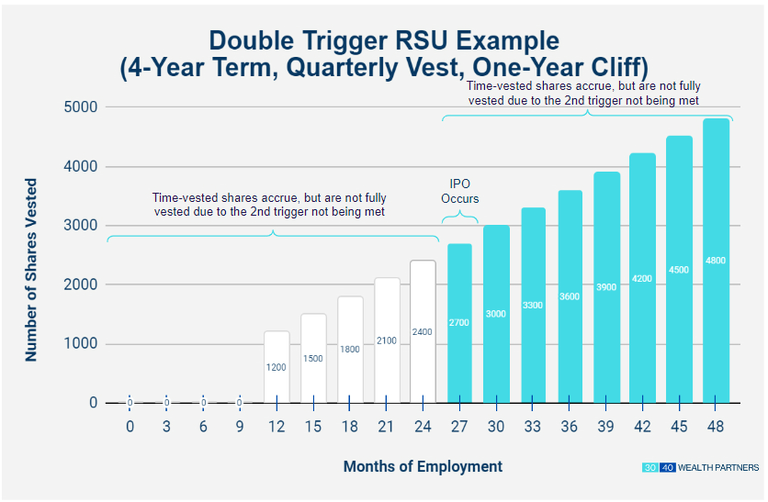
If you have double-trigger RSUs, by definition they will vest when both criteria are met. Many times this results in a large amount of shares vesting at one time, creating a spike in income
Strategy Overview
Double-trigger RSUs, by definition, vest when both two criteria are met. For employees who have been with the company for a while, this frequently results in a large amount of shares vesting at one time, creating both (1) a spike in income, and (2) some potentially unique withholding items that need to be properly planned for.
Tax Details
Double-trigger RSUs require that shares formally vests only if two criteria are met: (1) the normal employee time-vesting element, and (2) an exit/liquidity event must occur. They're the most commonly granted type of stock compensation for late-stage pre-IPO companies, as the double-trigger protects employees and the company from generating taxable income (and required income tax withholding).
Conversely, however, when a liquidity event does occur and the shares vest it frequently results in a large amount of shares vesting on a single date. This (atypical) large amount of vesting can require a number of decisions to be made, and tax planning items to consider:
Planning for a spike in income (into higher tax brackets). In many cases the atypical income from a double-trigger event will push you into a higher marginal tax bracket. Considering one or more income tax strategies may make sense for the year this occurs in.
Planning for a low withholding rate (and a future tax bill). As noted in Optimizing for RSU Underwithholding, RSUs have a different (lower) tax rate that companies must withhold at. But the vested value is still taxable income to you, and you will owe the difference come April (and should plan accordingly).
Do you get/need to decide on what withholding rate the company will use? In certain circumstances, your company may allow you to select a different withholding rate and/or amount of RSUs that are force-sold. Most specifically, for an IPO liquidity event, a number of companies have given employees the option of having 22% (the typical required rate) or 37% (the maximum federal income tax bracket) of their RSUs sold for tax withholding purposes
Key Benefits
No surprise come April (tax bill time). By knowing how your double-trigger RSUs and associated withholding work, you won't be surprised by the likely tax bill you owe in April (and ideally, have reserved cash for that purpose).
Make more informed decisions. In the event that you're given a choice regarding the amount of tax withholding you would like the company to utilize, knowing how this works will enable you to make a more appropriate decision.
Potentially utilize strategies to better manage your taxes. One or more income tax strategies may make sense to utilize in a year of higher income.
Key Considerations/Flags
Potentially limited control. Beyond being informed (and planning accordingly), you may not have any choices to make regarding how any of the above transpires
The "liquidity event date" for an IPO may not be the IPO date. Some liquidity event dates are deemed to be met as of the day of the IPO, while others occur once the lock-up period expires.
Strategy: When to Consider This and When to Avoid It
🟢When to Consider This Strategy:
If you have double-trigger RSUs with time-vested portions.
🔴When to Not Use This Strategy:
If you have do not have double-trigger RSUs (or your double-trigger RSUs have limited or no time-vested portions).
Example
For an example of a double-trigger RSU, see RSU Taxation/RSU Tax Examples
Work with 30/40 Wealth
Have a big equity or tax decision ahead?
We're a fee-only fiduciary for tech employees with a lot of company equity. We build your multi-year plan: when to exercise options, what to sell and when, and how to cut the tax bill. Then we stay with you for the years that follow.
You're likely a fit if:
- You have $2M+ in company equity, including options
- Your next big decision is coming up: an IPO or lockup, a tender offer, exercising options, selling a large position, or leaving your company
- You want ongoing help with all of it: your equity, taxes, investments and the plan that ties them together

Kris Barney, CFA, EA
$750M+ in equity compensation advised
Fees from $12,500 a year, based on the assets we manage
We take on 1–2 new clients a month
Book a 30-minute fit call →Free and no obligation. If we're not the right fit, we'll say so.
See who we work with →Most Similar
Selected by content similarity, not just shared category.
Next Step
Want this applied to your situation?
A 30-minute consult will tell you whether the framework in this article applies cleanly to your equity package — and if so, what the next three moves are. No pitch.